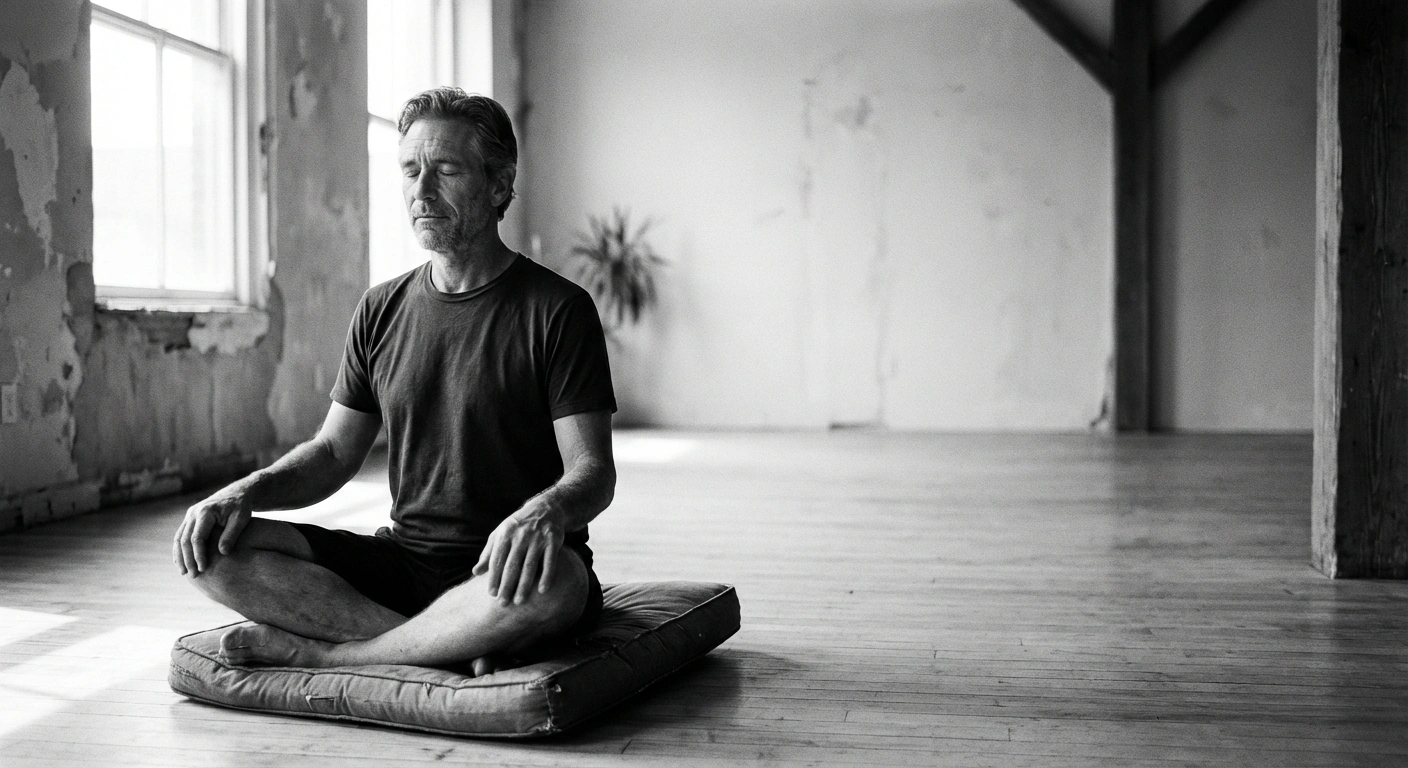
Most men who try meditation quit before the first week ends. Not because the practice is hard, but because nobody explained it correctly. You sit down, close your eyes, think about your grocery list for ten minutes, and conclude that meditation is not for you.
It works. The problem is the instruction.
This guide covers what meditation is, what the research shows about its effects on male hormones and mental health, five techniques suited to how men think, and a two-week schedule for building the habit from scratch.
Table of Contents
- Why Men Over 40 Should Take This Seriously
- The Testosterone and Cortisol Connection
- 5 Techniques That Work for Men
- Your First Two Weeks: A Practical Schedule
- Setting Up Your Practice
- Why Your Mind Wanders (And Why That's Fine)
- Common Beginner Mistakes
- FAQ
Why Men Over 40 Should Take This Seriously
After 40, the daily stress load compounds. Work pressure, financial responsibility, relationship demands, and the first signs of physical change layer on top of each other. Chronic stress at this life stage carries a specific physiological cost that it didn't carry in your twenties.
Stress triggers cortisol release. Short bursts of cortisol are useful. Sustained elevation, the kind that accumulates over years of unmanaged pressure, suppresses testosterone production, disrupts deep sleep, shrinks the hippocampus (the brain's memory and learning center), and raises cardiovascular risk.
A 2014 systematic review and meta-analysis in JAMA Internal Medicine analyzed 47 randomized trials with 3,515 participants. Mindfulness meditation programs produced moderate improvements in anxiety (effect size 0.38) and depression (effect size 0.30) at eight weeks. No harmful effects were found across any trial.
Men report anxiety and depression at rates comparable to women but seek treatment at roughly half the rate. Meditation is a tool you use alone, in private, at any time. That matters when asking for help feels like a barrier.
The Testosterone and Cortisol Connection
Testosterone and cortisol operate on a seesaw. When cortisol climbs, testosterone production falls. This is basic endocrine physiology, not theory. Low testosterone in men over 40 correlates with fatigue, reduced muscle mass, mood instability, and lower drive. Sustained cortisol elevation accelerates all of these.
A 2024 pilot randomized controlled trial published in Stress: The International Journal on the Biology of Stress examined the effect of seven 20-minute mindfulness sessions on male hormone response to acute stress. Men who completed the meditation protocol showed higher testosterone concentrations after stress exposure compared to the control group. The cortisol surge seen in controls was absent in the meditation group.
Seven sessions. Twenty minutes each. The hormonal signal was measurable.
Meditation does not replace other factors that protect testosterone, including sleep quality, body composition, and training. But it addresses one of the most direct upstream drivers of testosterone suppression: unregulated cortisol.
5 Techniques That Work for Men
Most meditation instruction teaches one style as if it suits everyone. It doesn't. Here are five approaches, each matched to a different preference.
1. Breath Focus (The Foundation)
Best for: Beginners who want a concrete focal point.
Sit upright in a chair or on the floor. Close your eyes. Breathe at your natural rate. Fix attention on the physical sensation of breath: the air entering through your nostrils, the rise of your chest, the release on the exhale. When a thought pulls you away, notice it, let it go, and return to the breath.
That is the complete instruction. The practice is not the absence of thought. The practice is the return. Each return builds attention control the way a rep builds muscle.
Start at 5 minutes. Extend to 15 over three weeks.
2. Body Scan
Best for: Men with physical tension, sleep problems, or difficulty sitting still.
Lie flat on your back. Close your eyes. Start at the crown of your head and move your attention down through each body part: forehead, jaw, neck, shoulders, chest, arms, abdomen, hips, thighs, calves, feet. At each location, notice what you feel without trying to change anything. Tension, warmth, numbness, or nothing at all.
The body scan is one of the core components of Mindfulness-Based Stress Reduction (MBSR), the protocol Jon Kabat-Zinn developed at UMass Medical School in 1979. MBSR has produced more published research than any other meditation protocol, including a 2011 Harvard study showing structural brain changes after eight weeks of practice.
Full body scans run 20 to 45 minutes. A 10-minute version works for beginners.
3. Open Monitoring
Best for: Men who process problems analytically and resist the idea of "emptying the mind."
Sit comfortably. Instead of narrowing to the breath, widen your attention to observe whatever arises: sounds, physical sensations, thoughts, emotions. Don't engage with the content. Watch each thing appear, stay briefly, and pass. You are the observer, not the thought.
Think of it as watching traffic from an overpass. You see the cars without being in them.
This technique suits analytical thinkers because it channels that tendency rather than fighting it. You are not emptying your mind. You are studying it.
4. Counting Meditation
Best for: Men who want structure and a built-in success metric.
Sit and close your eyes. On each exhale, count silently from one to ten. When you reach ten, start again from one. If you lose count, start again from one. No judgment, just restart.
The number sequence gives your mind a task. Most beginners find this more manageable than pure breath focus because the count catches wandering attention faster than the subtle sensation of breath.
5. Walking Meditation
Best for: Men who find seated practice uncomfortable, or who want to practice outdoors.
Walk at roughly 30% slower than your normal pace. Fix attention on the physical experience of movement: the lift of each foot, the moment of balance, the contact with the ground. When attention drifts, notice it and return to the sensation of walking.
Walking meditation removes the seated stillness barrier. Ten minutes before a difficult meeting or conversation produces measurable parasympathetic recovery, the physiological state opposite to the stress response.
Your First Two Weeks: A Practical Schedule
The most common failure mode is starting too ambitious. Seven days of 30-minute sessions collapse by day three. Use a graded approach.
Week 1: Anchor the Habit
The only goal in week one is attendance. Five minutes, same time each day. Morning works for most men because willpower has not yet been depleted by decisions. Right after waking, before checking your phone, is the highest-success window.
- Days 1 to 3: Breath focus, 5 minutes in the morning.
- Days 4 to 5: Add a body scan in the evening, 10 minutes lying down before sleep.
- Days 6 to 7: Breath focus, 5 minutes. Notice whether sleep quality has shifted at all.
Week 2: Extend and Explore
Extend morning sessions to 10 minutes. Introduce one different technique midweek. Counting meditation works well as the second technique because it contrasts directly with breath focus and reveals something about your own attention patterns.
- Days 8 to 10: Breath focus, 10 minutes.
- Day 11: Counting meditation, 10 minutes.
- Days 12 to 14: Your choice between the two. Notice which produces more post-session calm.
By day 14 the habit structure exists. The next step is extending sessions to 15 to 20 minutes, which is where most clinical research shows measurable change.
Setting Up Your Practice
You don't need a meditation cushion, a dedicated room, or silence. None of these are required.
What helps:
- A chair where your back stays straight without effort
- A timer set before you sit (removes the urge to check the clock)
- The same location each day (location becomes a cue that triggers the habit)
- No phone within reach
What matters less than commonly claimed:
- Silence: ambient noise is workable and teaches attention under real conditions
- Eyes open or closed: both work; closed is easier for most beginners
- Sitting cross-legged: sit in whatever position keeps your spine upright
Sara Lazar's lab at Harvard found in 2011 that participants who completed eight weeks of MBSR showed increased gray matter density in the hippocampus and decreased gray matter volume in the amygdala, the brain's threat-response center, compared to non-meditating controls. The protocol used 20 to 40 minutes of practice per day. You don't need more than that.
Why Your Mind Wanders (And Why That's Fine)
The most common reason men abandon meditation: their mind wanders, they conclude they're doing it wrong, and they quit.
The wandering is the practice.
When your attention drifts and you notice it, that noticing is the skill. The return is the repetition. Each session of wandering followed by repeated returns is equivalent to a resistance training session: you're building attentional capacity through controlled stress and recovery.
Harvard researchers published a 2010 experience-sampling study covering 2,250 adults. Human minds wandered during 47% of waking hours on average. Mind-wandering correlated directly with unhappiness. Meditation trains the return from mind-wandering. That is its primary mechanism.
For men dealing with anxiety symptoms, this is particularly relevant. Anxiety operates through thought chains: one worry leads to the next, which leads to catastrophizing. Meditation doesn't eliminate worry. It builds the skill of noticing when you've been pulled into a chain, and interrupting it. That interruption is the intervention.
Common Beginner Mistakes
Treating restlessness as failure. Physical restlessness during early sessions is expected. Your nervous system is not accustomed to stillness. Sit with it for the session length. It diminishes over days, not weeks.
Skipping when stressed. Men tend to skip their practice on exactly the days they need it most. Stress is the signal to sit, not to postpone.
Chasing the "good session." Some sessions produce calm. Some produce 15 minutes of frustrated distraction. Both count as practice. The target is habit consistency, not experience quality.
Expecting results in days. The literature consistently shows benefits emerging over weeks. Eight weeks appears repeatedly as the threshold for measurable structural and hormonal change. Commit to eight weeks before evaluating.
Using it as the only stress tool. Meditation handles cortisol regulation and attention control. Other inputs matter too: regular physical activity, adequate sleep, and addressing chronic stressors directly. None of these replace each other.
Meditation Within a Broader Men's Health Approach
Stress management doesn't happen through a single intervention. Meditation handles the cortisol and attention components. Other pillars of longevity for men over 40 include sleep optimization, progressive strength training, and cardiovascular fitness.
Men who combine daily meditation with adequate sleep report faster recovery from stress events and steadier emotional regulation under pressure. The mechanisms compound: meditation regulates the cortisol response, sleep clears stress hormones, exercise burns off excess adrenaline, and resistance training directly supports testosterone production.
Meditation costs 10 to 20 minutes per day. The compounding return on stress physiology, cognitive function, and sleep quality makes it one of the most efficient health investments available to men over 40.
FAQ
How long should a beginner meditate each day?
Start at five minutes daily for the first week. Extend to 10 minutes in week two, and 15 to 20 minutes by week four. Most studies showing measurable brain and hormonal changes used 20 to 40 minutes per day over eight weeks. The minimum effective dose appears to be 10 to 15 minutes daily when practiced consistently.
Do I need to sit cross-legged to meditate?
No. Sitting cross-legged without back support causes pain and distraction, both of which interfere with the practice. Sit in a chair with your back straight and feet flat on the floor. Any position that keeps your spine upright without effort works. The position matters because slouching suppresses breathing and causes drowsiness.
Can I use a meditation app?
Apps like Calm, Headspace, or Waking Up work for beginners because they eliminate the need to time yourself and provide guided structure. Use them as a starting scaffold. The eventual goal is to meditate without external guidance, because that is when you can practice anywhere, any time.
When is the best time to meditate?
Morning is the most consistently successful window for most men. Willpower hasn't been depleted by decisions yet, and the practice occurs before the day's demands compete with it. If morning is impossible, any consistent time works. Consistency of timing matters more than which hour you choose.
What is the difference between meditation and mindfulness?
Mindfulness is a quality of attention: present-moment awareness without judgment. Meditation is the formal practice that trains it. You can practice mindfulness while walking, eating, or talking. Formal meditation sessions build the attentional capacity that then transfers into informal mindfulness throughout the day.
Does meditation affect testosterone levels?
The evidence points toward a protective effect. A 2024 RCT found men who completed seven sessions of mindfulness meditation showed higher testosterone concentrations after acute stress compared to controls. Chronic cortisol, which meditation helps regulate, is the primary hormonal suppressant of testosterone production.
How do I know if meditation is working?
Look for these indicators: shorter recovery time after stressful events, improved sleep onset, reduced reactivity in situations that previously triggered strong emotional responses, and improved focus during demanding cognitive tasks. These changes emerge over weeks. Do not evaluate the practice based on how a single session feels.
Consult your healthcare provider before making changes to your health routine, especially if you are managing anxiety, depression, or other mental health conditions. This article is for educational purposes only and does not constitute medical advice.
Medical Disclaimer: This article is for informational purposes only and does not constitute medical advice. Always consult your healthcare provider before starting any new exercise, nutrition, or supplement program.