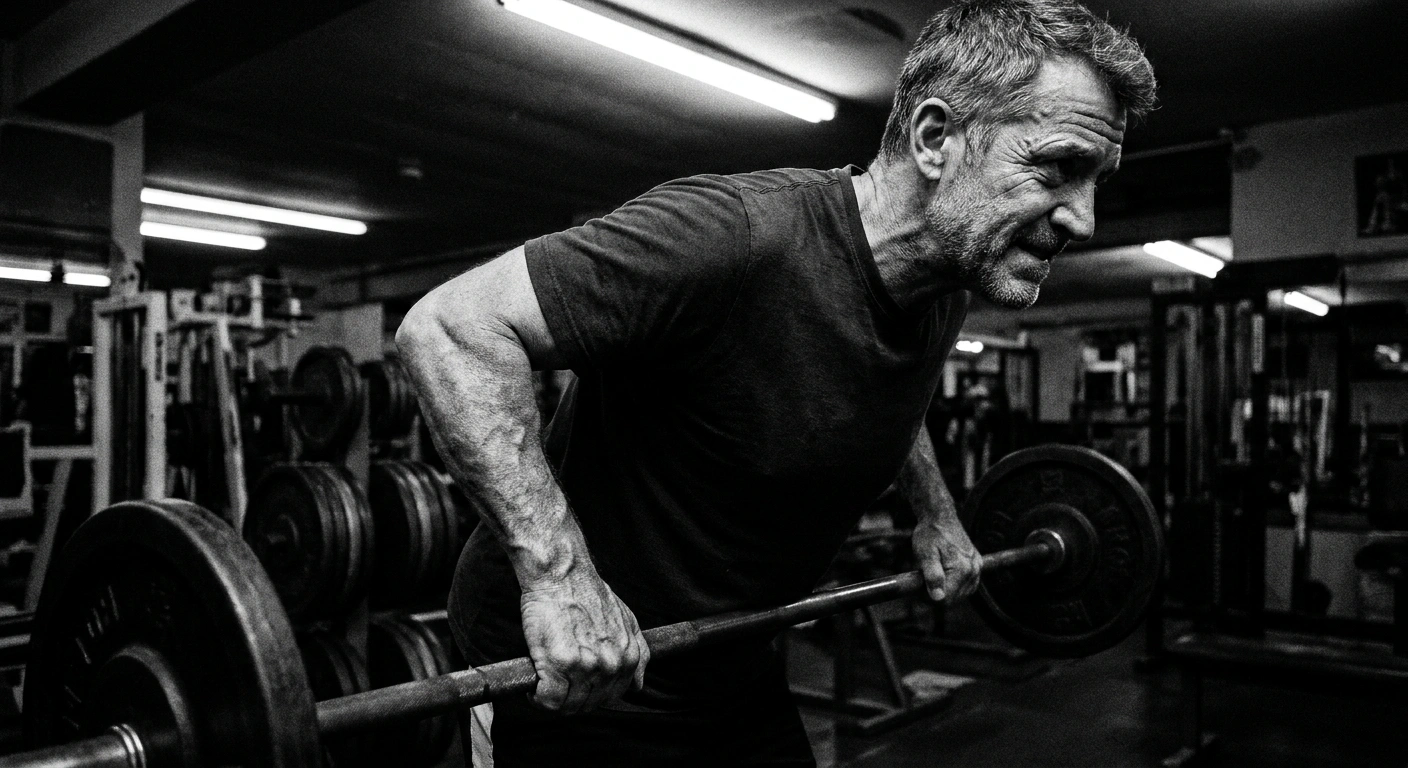
Most workout programs written for men over 40 make one of two mistakes. They ignore the recovery demands that come with age and pile on six training days like you're 22. Or they go so conservative that you spend three days a week doing resistance bands and call it strength training. The push pull legs split avoids both traps.
PPL organizes workouts by movement pattern: one session for pushing movements (chest, shoulders, triceps), one for pulling movements (back, biceps), one for legs. Run as a 3-day program, every muscle group trains once per week. Run as a 6-day program, every muscle group trains twice. For men over 40, the 3-day version sits in the right zone — enough frequency to drive hypertrophy, enough rest to allow full recovery between sessions.
A 2016 meta-analysis in Sports Medicine by Brad Schoenfeld and colleagues analyzed 25 studies and found that training a muscle group twice per week produces 28% more muscle growth than training it once. The 6-day PPL hits that frequency, but men over 40 rarely have the recovery capacity to benefit from it. That's not a limitation to work around — it's a physiological reality to train with.
This guide gives you the complete 3-day PPL program, the rationale behind every programming decision, and the modifications that make it work for real bodies in their 40s and 50s.
Key Takeaways
- Push pull legs splits organize training by movement pattern, minimizing overlap and keeping recovery clean
- Men over 40 get better results from 3-day PPL than 6-day due to the 48-72 hour satellite cell recovery window that extends with age
- Rep ranges of 8-15 reduce joint stress while still producing meaningful hypertrophy
- Face pulls on every pull day protect rotator cuff health — the most overlooked piece of shoulder maintenance after 40
- Double progression (add reps before adding weight) keeps loading conservative and sustainable over months of training
Why PPL Works Well After 40
Three features make push pull legs suited to older trainees.
Movement pattern logic. Each workout targets muscles by how they function together. A push day trains chest, shoulders, and triceps — the muscles that drive pushing movements. A pull day trains back and biceps — the antagonists. Legs get their own session. There's no redundancy, no overlap, and no confusion about what to train when.
This matters for recovery. When you organize training around opposing muscle groups, you can train on consecutive days without hitting the same muscles twice. Back-to-back push and pull days work because pushing muscles rest on pull day and vice versa. Men over 40 who run chest on Monday and shoulders on Wednesday often find their shoulders still carry fatigue from Monday's pressing. PPL eliminates that problem by design.
Adjustable volume. Total sets scale based on your recovery capacity. A conservative approach uses 15 sets per session. A more aggressive approach runs 20-22 sets. You can adjust based on how your body responds week to week without rebuilding the program from scratch.
Schedule flexibility. Run it 3 days per week. Add a second cycle if you have the recovery for 5 days. Take an extra rest day after a hard week at work or poor sleep. PPL accommodates real life in a way that rigid daily splits don't.
3-Day vs 6-Day: Why 3 Days Wins After 40
A 6-day PPL runs Push-Pull-Legs-Push-Pull-Legs through the week, training each muscle group twice. In younger men with fast recovery, this accelerates results.
After 40, recovery slows for documented reasons. Satellite cells — the stem cells responsible for repairing muscle fiber damage after training — take longer to activate in older trainees. Research published in Biology (Basel) found that satellite cell activation peaks around 48 hours post-exercise in young men, and at 72 hours in men over 40. The repair process itself starts later.
Testosterone and growth hormone also decline with age at roughly 1-2% per year after 30 for testosterone and at a steeper rate for growth hormone during deep sleep. Both drive muscle protein synthesis and recovery. Lower baseline levels mean a given training load demands more time to recover from.
The 3-day PPL runs Push on Monday, Pull on Wednesday, Legs on Friday — or any configuration with at least one rest day between sessions. Each muscle group gets 72-96 hours before its next session. That gap aligns with the actual recovery window, not the one you had in your 20s.
Can men over 40 run 6-day PPL? Yes, with the right conditions: years of consistent training, 7-9 hours of sleep, eating at or above maintenance, and no chronic joint issues. If you're returning after a break, building from scratch, or carrying ongoing soreness, start with 3 days.
The Complete 3-Day PPL Program for Men Over 40
Run each session once per week with at least one full rest day between sessions. Warm up for 10 minutes before each workout: 5 minutes of light cardio, followed by 5 minutes of dynamic mobility targeting the muscles you'll be training. For a complete daily warm-up routine, see the best daily stretching routine for men over 40.
Use 8-12 reps for compound exercises and 12-15 reps for isolation work. These ranges produce hypertrophy while keeping loads conservative enough to protect connective tissue. Rest 2-3 minutes between compound sets and 60-90 seconds between isolation sets.
Day 1: Push (Chest, Shoulders, Triceps)
| Exercise | Sets | Reps | Notes |
|---|---|---|---|
| Flat Barbell or Dumbbell Bench Press | 3 | 8–12 | Primary chest compound. Use dumbbells if shoulder discomfort on barbell |
| Incline Dumbbell Press | 3 | 10–12 | Upper chest emphasis. Keep elbows at 45° to reduce shoulder strain |
| Seated Dumbbell Shoulder Press | 3 | 10–12 | Dumbbells allow a more natural shoulder path than barbell overhead press |
| Lateral Raises (cables or dumbbells) | 3 | 12–15 | Control the lowering phase. Do not jerk the weight up |
| Tricep Rope Pushdown | 3 | 12–15 | Keep elbows tucked. Full extension at the bottom |
| Overhead Tricep Extension | 2 | 12–15 | Long head emphasis. Use cable or single dumbbell |
Total: 17 working sets
Day 1 notes for men over 40: Flat barbell pressing can aggravate the acromioclavicular joint or produce clicking in men who have accumulated shoulder wear. If this happens, switch to dumbbells. Dumbbells let the wrists and elbows find their natural alignment rather than being locked into the barbell path. Keep incline press angle at 30-45 degrees — steeper angles shift load to the anterior deltoid and can irritate the biceps tendon over time.
Day 2: Pull (Back, Biceps)
| Exercise | Sets | Reps | Notes |
|---|---|---|---|
| Barbell Bent-Over Row or Dumbbell Row | 3 | 8–12 | Hinge at the hip, brace the core. Use DB row if low back is an issue |
| Pull-Ups or Lat Pulldown | 3 | 8–12 | Underhand grip reduces elbow strain. Assisted pull-ups are equally valid |
| Seated Cable Row (neutral grip) | 3 | 10–12 | Pause and squeeze at the contraction point |
| Face Pulls | 3 | 15–20 | Pull to forehead height. This is not optional. Protects rotator cuff and rear delts |
| Dumbbell Curl | 3 | 10–12 | Supinate fully at the top. Full range of motion at the bottom |
| Hammer Curl | 2 | 12–15 | Brachioradialis emphasis. Less elbow stress than a straight curl |
Total: 17 working sets
Day 2 notes for men over 40: Face pulls are the most important prehab movement in this program. Men who bench press without balancing horizontal pulling develop anterior shoulder dominance and internal rotation tightness. Three sets of face pulls every pull day corrects that imbalance. Never skip them. If you have lateral elbow pain (tennis elbow), swap barbell curls for cable curls — cables maintain constant tension and avoid the empty-load bottom position where strain is greatest.
Day 3: Legs (Quads, Hamstrings, Glutes, Calves)
| Exercise | Sets | Reps | Notes |
|---|---|---|---|
| Barbell Back Squat or Goblet Squat | 3 | 8–12 | Goblet squat if knees or low back are a concern |
| Romanian Deadlift | 3 | 10–12 | Hinge pattern. Neutral back, feel the stretch in hamstrings |
| Leg Press | 3 | 12–15 | High and wide foot position targets glutes; low and narrow targets quads |
| Walking Lunges | 3 | 10–12 per leg | Builds unilateral strength and glute activation. Add dumbbells when ready |
| Lying or Seated Leg Curl | 3 | 12–15 | Hamstring isolation. Full range of motion |
| Standing Calf Raise | 4 | 15–20 | Slow lowering phase (3 seconds). Calves respond to high volume |
Total: 19 working sets
Day 3 notes for men over 40: Knee health determines squat choice. Goblet squats provide equivalent quad activation to back squats with less spinal load and a more upright torso, which is easier on the knees. Add a 5-minute hip flexor opener before squats — tight hip flexors from prolonged sitting are the most common cause of squat form breakdown in men over 40, often presenting as lower back strain during the ascent. For targeted knee-friendly alternatives, see low impact exercises for men with bad knees.
Exercise Substitutions for Common Issues
Men over 40 often carry training history: old injuries, chronic joint wear, or persistent tightness. These swaps preserve training intent while working around genuine limitations.
| If You Have | Replace This | With This |
|---|---|---|
| Shoulder impingement | Barbell bench press | Dumbbell floor press or low-cable fly |
| Lower back pain | Barbell bent-over row | Single-arm dumbbell row or seated cable row |
| Knee pain during squats | Barbell back squat | Goblet squat, box squat, or leg press |
| Lateral elbow pain | Barbell curl | Cable curl with supinated grip |
| Wrist discomfort on pressing | Barbell bench or OHP | Neutral-grip dumbbell press |
The goal is always a pain-free movement in the same pattern. A goblet squat is still a squat. A cable row is still a row. You're not avoiding the movement — you're finding the variation that loads the target muscle without loading the injury.
Progressive Overload After 40
Muscle growth requires progressive overload: load, volume, or training density must increase over time. After 40, double progression is the most sustainable method.
How double progression works: Choose a rep range with a floor and ceiling — for example, 8 to 12. When you complete all sets at the top of the range with good form, add 5 lbs at the next session and work back up to the ceiling. This creates consistent strength gains without aggressive loading jumps that connective tissue can't absorb.
In practice:
- Session 1: Bench press 135 lbs — 10, 9, 8 reps
- Session 2: 135 lbs — 12, 11, 10 reps
- Session 3: 135 lbs — 12, 12, 12 reps (ceiling reached)
- Session 4: 140 lbs — 9, 8, 8 reps (start building back up)
Progress looks slow on paper. That's the design. Connective tissue (tendons, ligaments, cartilage) adapts more slowly than muscle in men over 40. Aggressive loading jumps build strength faster than tendons can adapt, and the result is the kind of tendon injuries that shut down training for months. Double progression protects the connective tissue that sustains long-term progress.
For a deeper look at building muscle without injury, see how to build muscle after 40 naturally.
Recovery Between Sessions
Resistance training works by creating controlled muscle damage. Recovery is where growth happens. Without adequate recovery, training produces net damage instead of net growth.
The American College of Sports Medicine recommends 48-72 hours between resistance sessions targeting the same muscle group for adults over 40. The 3-day PPL structure delivers this automatically — push on Monday means the chest gets 96+ hours before the next push session.
Four practices that improve recovery for men over 40:
Protein intake. Consume 35-40g of protein within 90 minutes of training. Anabolic resistance increases with age, meaning older muscle requires a larger leucine dose to trigger muscle protein synthesis. Spreading protein across 3-4 meals of 35-40g each produces better outcomes than concentrating the same daily total in fewer meals. See how much protein does a 45-year-old man need for specific daily targets.
Sleep quality. Growth hormone releases during slow-wave sleep in the early part of the night. A 2011 study in JAMA found one week of sleeping 5 hours per night reduced testosterone by 10-15% in young men. The effect is larger in older men. Target 7-9 hours with a consistent sleep schedule. See how to improve sleep quality for men over 40 for practical strategies.
Deload weeks. Every 4-6 weeks, cut training volume by 40-50% for one week — same exercises and weights, half the sets. Deloads allow connective tissue repair that active training blocks prevent. Men over 40 who feel chronically beaten up from training are almost always under-deloading rather than overtraining in the traditional sense.
Creatine monohydrate. The most evidence-backed supplement for strength training. A consistent 3-5g daily dose increases phosphocreatine stores, improves work capacity during high-intensity sets, and supports faster recovery between sessions. Multiple meta-analyses support its effectiveness in older adults. It's inexpensive and has no meaningful side effects at this dose in healthy adults.
Sample Weekly Schedule
| Day | Training |
|---|---|
| Monday | Push (Chest, Shoulders, Triceps) |
| Tuesday | Rest or 20-30 min Zone 2 cardio |
| Wednesday | Pull (Back, Biceps) |
| Thursday | Rest or 20-30 min Zone 2 cardio |
| Friday | Legs (Quads, Hamstrings, Calves) |
| Saturday | Light activity: walking, mobility work |
| Sunday | Full rest |
Zone 2 cardio on rest days supports cardiovascular health without competing with strength recovery. It keeps aerobic capacity and metabolic health in place without the high-intensity signals that interfere with leg training. For the research behind Zone 2 and why it matters for men over 40, see Zone 2 cardio for longevity.
FAQ
Can men over 40 do a push pull legs split?
Yes. PPL is one of the more appropriate splits for men over 40 because it organizes training to allow full recovery between sessions for each muscle group. The 3-day version gives every muscle 72-96 hours of rest, which aligns with the extended satellite cell activation window that comes with age.
How many sets should men over 40 do per workout?
15-20 working sets per session is the appropriate range for most men. Start at the lower end (12-15 sets) and add volume as recovery capacity confirms you can handle more. Research shows diminishing returns beyond 20 sets per session, and excess volume raises injury risk more in men over 40 than in younger trainees due to slower connective tissue repair.
Is PPL better than full body training for men over 40?
Both are effective for different stages of training. Full body training hits each muscle three times per week with lower per-session volume, which suits men returning from a long break or building a foundation. PPL allows higher per-session volume per muscle group and suits men with 1-2+ years of consistent training. If you're early in your lifting history, a full body workout routine is a better starting point.
How long should I rest between sets?
2-3 minutes between compound exercises (bench press, rows, squats, Romanian deadlifts). 60-90 seconds between isolation exercises (curls, lateral raises, tricep pushdowns). A study in the Journal of Strength and Conditioning Research found that 3-minute rest intervals produced greater strength and hypertrophy gains than 1-minute intervals, attributed to fuller phosphocreatine recovery and better hormonal conditions between sets.
When will I see results on PPL?
Strength gains appear in 2-4 weeks as neural adaptations improve. Visible muscle changes take 6-8 weeks with consistent training and sufficient protein. Noticeable body composition shifts — less fat, more muscle density — are typical by 12-16 weeks. Strength progress shows up in your logbook well before it shows up in the mirror.
Do I need cardio alongside this program?
20-30 minutes of low-intensity cardio on 2-3 rest days maintains cardiovascular health without impeding strength recovery. Avoid high-intensity cardio within 24 hours of a leg session — HIIT and heavy leg training send competing adaptation signals. Walking, cycling at a comfortable effort, or rowing at Zone 2 intensity on non-lifting days is the right combination.
Putting It Together
The push pull legs routine for men over 40 is not a simplified version of a real program. It's a structure that treats recovery as a training variable from the start. Three days per week, clear movement patterns organized by function, rep ranges that respect joint health, and progression that doesn't outpace connective tissue.
Run this program for 12 weeks. Take a deload at week 4 and week 8. Log your weights and reps every session. Eat 0.8-1.0g of protein per pound of bodyweight daily. Sleep 7-9 hours.
For most men over 40, that combination produces more measurable strength and muscle than any more complicated approach — including the ones they were running at 30.
Medical disclaimer: Consult your doctor before starting a new resistance training program, particularly if you have existing joint conditions, cardiovascular disease, hypertension, or have been sedentary for an extended period. This article is for educational purposes only and does not constitute medical advice.
Medical Disclaimer: This article is for informational purposes only and does not constitute medical advice. Always consult your healthcare provider before starting any new exercise, nutrition, or supplement program.