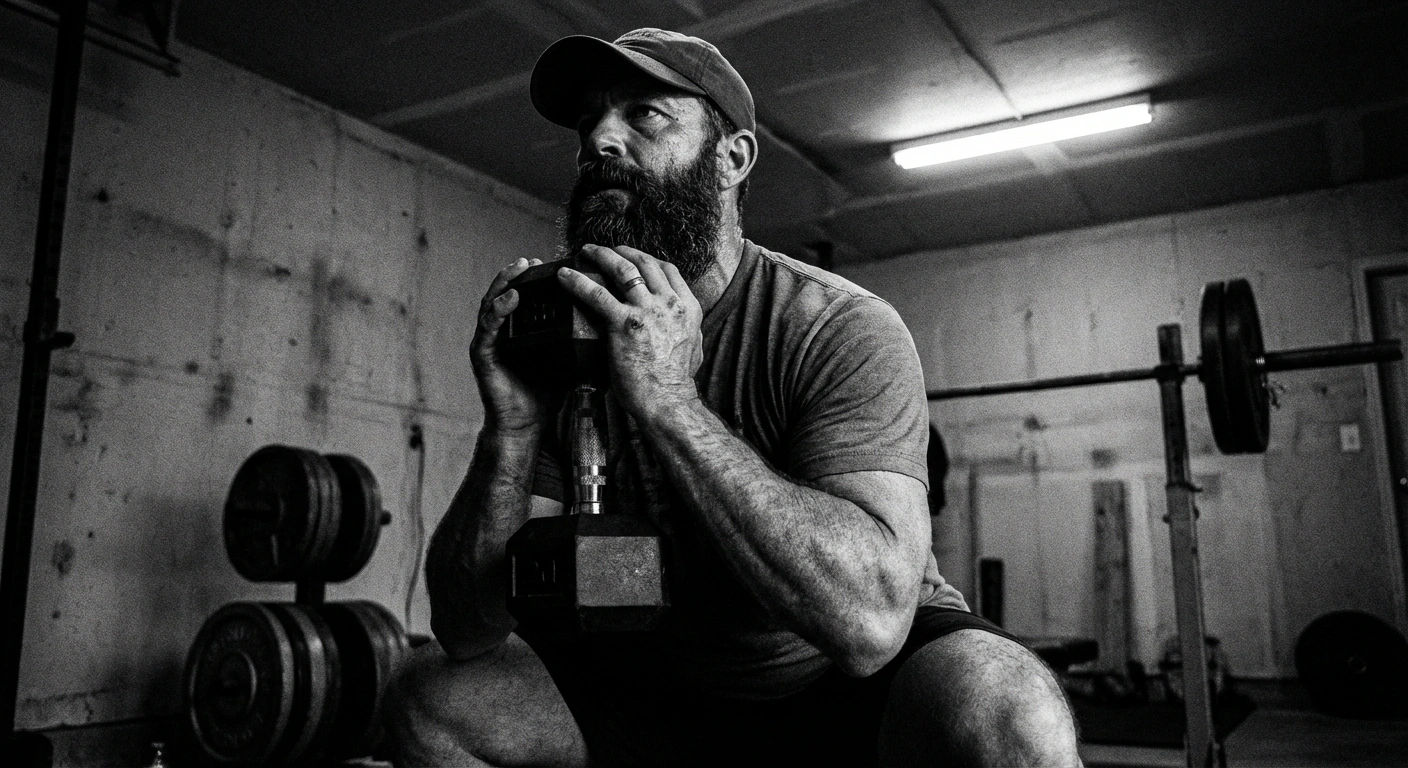
Men over 50 who lift consistently carry more muscle, break fewer bones, and outlive their sedentary peers by measurable margins. A 2022 systematic review in Nature Scientific Reports found that resistance training cut all-cause mortality risk by 15% in older adults, independent of cardiovascular exercise. This program is built around that evidence.
Three days per week. Full body. Progressive. No gimmicks.
Key Takeaways
- Three sessions per week gives men over 50 enough frequency to stimulate muscle protein synthesis without overloading joints and connective tissue
- Compound movements (squats, deadlifts, rows, presses) drive the strongest hormonal response and the most muscle adaptation
- After 50, untrained men lose 1-2% of lean muscle mass each year. The program exists to reverse that
- You need 48-72 hours between sessions hitting the same muscles. This program builds that in
- Progressive overload, tracked in a log, is the difference between training and exercising
Why Training Shifts After 50
Testosterone levels in men over 50 sit 25-30% lower than at age 30, according to data from the National Institutes of Health. Growth hormone secretion drops by roughly 14% per decade after age 40. These hormonal changes do not prevent muscle growth. They do mean recovery takes longer, strength gains come more slowly, and training errors cost more.
Sarcopenia compounds the problem. A meta-analysis published in PMC (2022), reviewing 13 randomized controlled trials, confirmed that between ages 50 and 80, untrained men lose approximately 30% of their skeletal muscle mass. The researchers also confirmed that resistance training reversed this trend, producing measurable improvements in grip strength, gait speed, and skeletal muscle index in men with diagnosed sarcopenia.
The answer is not to train less. It is to train with more precision: more recovery between sessions, more attention to joint integrity, and a program organized around compound movements rather than isolation work.
For men newer to the weight room, our beginner strength training program for men over 40 covers foundational movement patterns before you tackle this program.
How the 3-Day Program Works
This program follows an alternating A/B structure run three days per week, with at least one full rest day between sessions.
Week 1: Day A (Mon), Day B (Wed), Day A (Fri) Week 2: Day B (Mon), Day A (Wed), Day B (Fri)
This gives each muscle group three to four exposures over a two-week block, hitting the 10+ sets per muscle group per week threshold that research identifies as the minimum stimulus for hypertrophy in older adults (Sports Medicine, 2017).
Each session runs 45-55 minutes. That window provides enough volume to drive adaptation without the cortisol elevation that blunts testosterone and impairs recovery in men over 50.
Universal training parameters:
- Rest between compound sets: 90-120 seconds
- Rest between accessory sets: 60-90 seconds
- Warm-up: 10 minutes (see protocol below)
- Progression: Follow the double progression method (explained in the progressive overload section)
Day A: Squat and Press
| Exercise | Sets | Reps | Notes |
|---|---|---|---|
| Goblet Squat | 3 | 8-10 | Dumbbell or kettlebell held at chest. Drive knees out over toes. |
| Dumbbell Bench Press | 3 | 8-10 | Full range. Brief pause at the bottom of each rep. |
| Dumbbell Romanian Deadlift | 3 | 10-12 | Hinge at hips. Keep the weight close to the body throughout. |
| Single-Arm Dumbbell Row | 3 | 10 each | Brace the core. Drive elbow toward hip, not toward the shoulder. |
| Dumbbell Overhead Press | 3 | 10-12 | Seated or standing. Keep ribs down to avoid lumbar extension. |
| Plank | 3 | 30-45 sec | Straight line from head to heel. No sagging at the hips. |
Why these movements: The goblet squat loads the anterior core while building hip mobility and teaching squat mechanics under moderate load. The Romanian deadlift develops the posterior chain (hamstrings, glutes, lower back) with lower spinal loading than a conventional barbell deadlift. Both movements target the muscle groups most prone to rapid atrophy in sedentary men over 50.
Day B: Hinge and Pull
| Exercise | Sets | Reps | Notes |
|---|---|---|---|
| Trap Bar Deadlift | 3 | 6-8 | Neutral grip reduces lumbar stress. Sub conventional deadlift if no trap bar is available. |
| Goblet Split Squat | 3 | 8 each leg | Front foot elevated 2-4 inches for greater range of motion. |
| Incline Dumbbell Press | 3 | 10-12 | 30-45 degree incline. Healthier shoulder position than flat bench for older trainees. |
| Lat Pulldown or Assisted Pull-Up | 3 | 8-10 | Lean back 10-15 degrees. Pull elbows toward the rib cage. |
| Band or Cable Pull-Apart | 3 | 15 | Arms straight. Squeezes rear delts and rotator cuff. Non-negotiable for shoulder health. |
| Dead Bug | 3 | 8 each side | Slow and controlled. Lower back stays flat against the floor throughout. |
Why these movements: The trap bar deadlift allows heavier loading with a more upright torso. Research published in the Journal of Strength and Conditioning Research (2011) found that trap bar deadlifts produce greater peak force output than barbell deadlifts, making them an effective primary lift for men whose lower backs need managing. Pull-aparts and the dead bug address the rotator cuff and deep core stabilizers. Both structures are commonly the first to fail in men over 50 who train without addressing them.
The Logic Behind the A/B Split
Day A is squat-dominant and pushing-focused. Day B is hinge-dominant and pulling-focused. Both days train the full body. The alternating emphasis prevents any one movement pattern from accumulating more volume than connective tissue can absorb, while keeping each muscle group within the 72-hour recovery window research recommends.
If you experience knee discomfort during squats or split squats, our guide to low-impact exercises for men with bad knees covers substitution options that protect the joint while preserving training volume.
Warm-Up Protocol (10 Minutes)
Do not skip this. Connective tissue in men over 50 takes significantly longer to warm up than muscle tissue, and cold tendons tear.
Minutes 1-3: Light cardiovascular activation Three minutes on a stationary bike, treadmill walk, or jumping jacks at low effort. Enough to raise heart rate to 100-110 BPM.
Minutes 3-7: Movement preparation Perform each movement for 8-10 reps:
- Hip circles, 8 each direction
- Bodyweight squat with a slow three-second descent, 10 reps
- Arm circles forward and backward, 10 each direction
- Hip hinge with a dowel or broomstick along the spine, 10 reps
- Band pull-apart, 10 reps
Minutes 7-10: Ramp-up sets for the first compound exercise On Day A (goblet squat) and Day B (trap bar deadlift), before your first working set:
- Set 1: 50% of working weight, 5 reps
- Set 2: 70% of working weight, 3 reps
- Then start your working sets
Progressive Overload: How to Keep Growing
Progressive overload is the mechanism that forces muscles to adapt. Without it, you maintain at best.
Use the double progression method:
- Each session, aim to add one rep to at least one set
- When you complete all prescribed sets at the top of the rep range (for example, all three sets at 10 reps when the range is 8-10), add weight at the next session: 5 lbs for lower body movements, 2.5-5 lbs for upper body movements
- Return to the bottom of the rep range with the new load and build again
Track your lifts in a log. A paper notebook or a spreadsheet both work. Without records, you are guessing.
Deload every 6-8 weeks. Drop all weights by 40-50% for one week and reduce to two sets per exercise. This clears accumulated fatigue, allows connective tissue to recover, and lets your nervous system reset. Men over 50 who skip deloads plateau within 12 weeks. Men who deload continue progressing well past 12 months.
Adding Cardiovascular Training
This program builds strength. It does not replace cardiovascular training.
The American Heart Association recommends 150-300 minutes of moderate-intensity cardiovascular exercise per week. Zone 2 cardio (a pace where you can hold a conversation but breathing is clearly elevated) provides the greatest metabolic and longevity benefit. Our guide on zone 2 cardio for longevity explains how to structure this alongside resistance training without undermining recovery.
On rest days, a 30-45 minute brisk walk counts as Zone 2 cardio. It also serves as active recovery, improving circulation to trained muscles without adding meaningful training stress.
Sample 4-Week Schedule
| Week | Monday | Wednesday | Friday |
|---|---|---|---|
| 1 | Day A | Day B | Day A |
| 2 | Day B | Day A | Day B |
| 3 | Day A | Day B | Day A |
| 4 | Deload | Deload | Deload |
After the deload week, restart at week 1 with slightly heavier starting weights based on your progress log.
Nutrition: What the Program Requires
Muscle protein synthesis rates decline with age. Men over 50 need more dietary protein than younger trainees to produce the same anabolic response. A 2015 study in the Journal of Nutrition demonstrated that older adults required higher per-meal protein doses (40g versus 20g) to maximally stimulate muscle protein synthesis.
Target 1.6-2.2 grams of protein per kilogram of body weight per day, distributed across three to four meals. For a 185 lb (84 kg) man, that is 135-185g of protein daily.
Meal timing: a meal containing 30-40g of protein 60-90 minutes before training improves session output. A post-workout meal with 30-40g of protein and carbohydrates consumed within two hours of finishing the session supports recovery.
For a complete nutrition framework, our high-protein diet plan for men over 40 includes weekly meal plans scaled to the right caloric targets.
Recovery: The Other Half of the Program
Training breaks tissue down. Recovery builds it back stronger. After 50, recovery matters at least as much as the training itself.
Sleep: Get 7-9 hours. A 2020 study in Current Biology confirmed that one week of restricted sleep (under six hours per night) reduced anabolic hormone production by 10-15% and cut muscle protein synthesis rates. Our guide to improving sleep quality for men over 40 covers the evidence-based interventions.
Joint support: If you experience persistent joint discomfort in the knees, hips, or shoulders, glucosamine, chondroitin, and omega-3 fatty acids have the strongest evidence base for joint support in older adults. Our breakdown of best joint supplements for men over 50 covers what the research actually supports versus what is marketing.
FAQ
How much weight should I start with?
Start with a weight you can lift with clean form across all sets. Form matters more than the number. For most men starting this program, goblet squats with 20-30 lbs and dumbbell rows with 25-40 lbs are appropriate entry points. Adjust based on your current strength level and use the double progression method to move forward from there.
What if I can only train two days per week?
Two days per week still produces real results. Run Day A and Day B with at least two days of rest between sessions. Research shows twice-weekly training produces 60-70% of the muscle growth seen with three times weekly, with faster recovery between sessions. It is a solid option for men with schedule constraints.
Should I do cardio on the same day as lifting?
Yes, when necessary. If you combine them, lift first, then do cardio. Performing cardio before lifting reduces strength output by 5-8% in the following session, according to research in the European Journal of Applied Physiology (2012). After lifting, keep cardio to 20-30 minutes at low intensity to avoid suppressing the anabolic response.
What if my lower back hurts during deadlifts?
Switch to the trap bar variation if you have not already. If discomfort continues, replace deadlifts with hip thrusts (barbell or dumbbell) for four to six weeks. Hip thrusts train the glutes and hamstrings with minimal spinal loading. Address the underlying cause with a physiotherapist rather than working around the problem for months.
How long before results are visible?
Strength improvements are measurable within two to four weeks. Visible changes in muscle size take eight to twelve weeks of consistent training, progressive overload, and adequate protein intake. Expect primary lift numbers to increase by 20-40% over a twelve-week block when training, nutrition, and sleep are all managed.
Can I do this program without a gym?
The goblet squat, RDL, and overhead press all work with dumbbells at home. The trap bar deadlift requires a trap bar, but a dumbbell deadlift substitutes well. The lat pulldown requires a cable machine or a resistance band anchored overhead. A set of adjustable dumbbells ranging from 10-75 lbs handles roughly 80% of this program without a gym membership.
Medical disclaimer: Consult your physician before starting any new exercise program, particularly if you have cardiovascular disease, orthopedic conditions, diabetes, or have been sedentary for an extended period. This article is for informational purposes only and does not constitute medical advice. If you experience chest pain, dizziness, or joint pain during exercise, stop training and seek medical evaluation.
Medical Disclaimer: This article is for informational purposes only and does not constitute medical advice. Always consult your healthcare provider before starting any new exercise, nutrition, or supplement program.