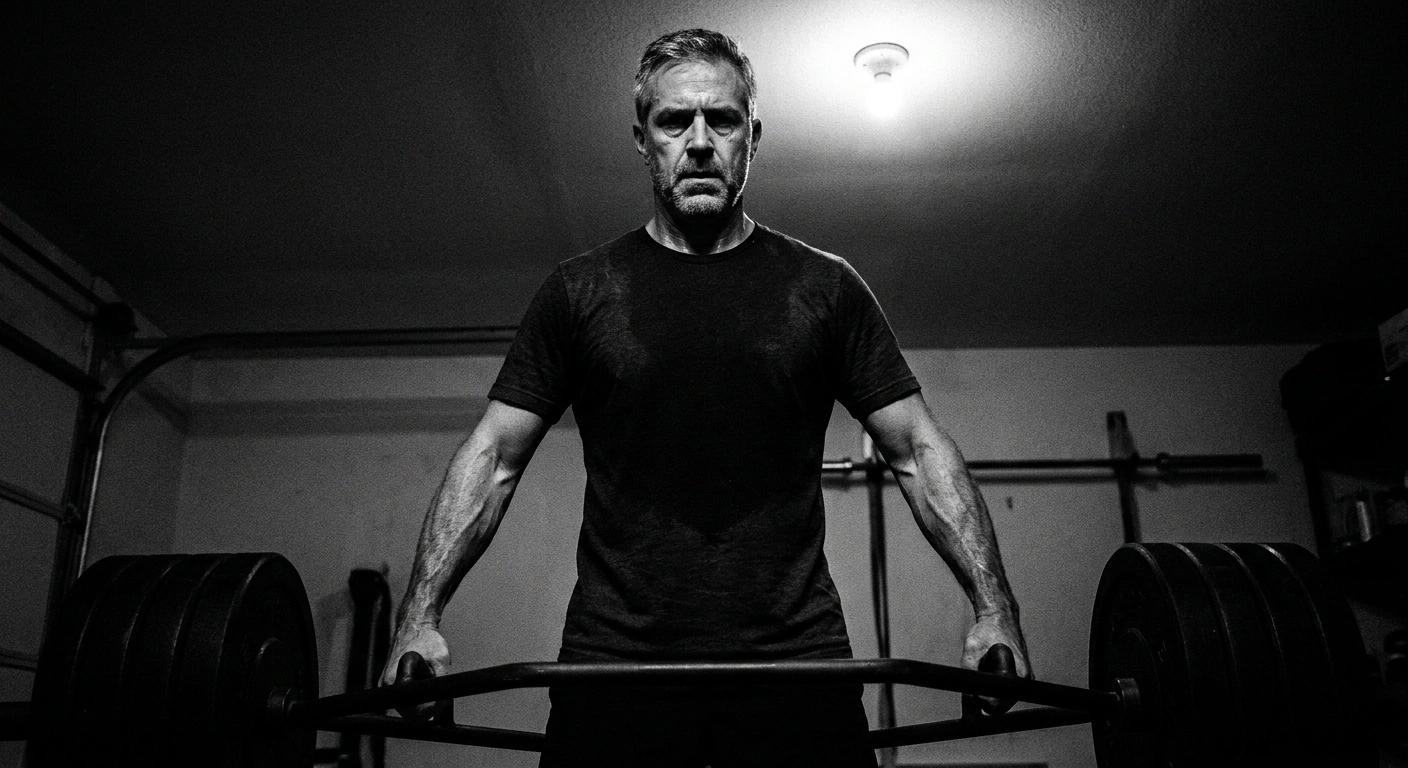
After 45, men lose 3-8% of muscle mass per decade when sedentary -- a number that can accelerate to 15% per decade after 70 (Volpi et al., Journal of Physiology, 2004). Compound exercises are the most effective counter. They work multiple muscle groups at once, produce greater testosterone and growth hormone responses than isolation work, and train the movement patterns that keep you functional as you age.
These 10 exercises are selected for men over 45 specifically: joint-friendly where the standard version creates excessive wear, weighted toward the muscle groups most vulnerable to age-related decline (posterior chain, upper back, glutes), and chosen for their return on investment when training time is limited.
This guide is for men aged 45-65 who lift or want to start lifting -- whether you train at a gym, a garage setup, or a commercial facility. No Olympic lifting background required.
Key Takeaways
- After 45, muscle loss runs 3-8% per decade without resistance training; compound exercises are the most effective defense
- Multi-joint movements produce larger testosterone and growth hormone responses than isolation exercises
- A 2022 JAMA Internal Medicine meta-analysis linked 1-2 strength sessions per week to 17% lower all-cause mortality
- The 10 exercises below prioritize joint-friendliness, posterior chain strength, and single-leg stability
- Target 48-72 hours of recovery between sessions working the same muscle groups
- Protein target for men over 45: 1.6-2.2g per kilogram of bodyweight daily
In this article:
- Why Compound Movements Matter More After 45
- The 10 Best Compound Exercises
- How to Program These Exercises
- Protein and Recovery
- Frequently Asked Questions
Why Compound Movements Matter More After 45
By 45, testosterone has been falling at roughly 1-2% per year since your early 30s. Growth hormone follows the same trajectory. Both hormones drive muscle protein synthesis -- the biological process of building and repairing muscle after training.
Multi-joint compound exercises produce a larger acute hormonal response than single-joint isolation work. Research in the Journal of Applied Physiology (Kraemer et al., 1991) showed squats and deadlifts generate measurably greater post-exercise testosterone and growth hormone spikes than machine-based exercises. When your anabolic environment is already reduced by age, maximizing the hormonal response per training session matters.
The mortality case for compound training is equally strong. A 2022 meta-analysis in JAMA Internal Medicine tracked 1.5 million adults and found strength training 1-2 times per week associated with 17% lower all-cause mortality and 19% lower cardiovascular mortality. The benefit plateaued at 2 sessions per week -- more training did not add longevity benefit beyond that threshold.
Compound movements also train movement patterns rather than muscles in isolation. Squatting, hinging, pressing, rowing, and carrying map directly to the demands of daily life. Maintaining these patterns as you age is directly tied to functional independence.
The 10 Best Compound Exercises for Men Over 45
1. Goblet Squat
The goblet squat is the starting point for any lower-body compound work after 45. You hold a dumbbell or kettlebell against your chest, which shifts your center of mass forward, keeps your torso upright, and reduces lumbar shear force compared to a barbell back squat.
Spinal discs deteriorate with age. A 2019 study in Spine measured lumbar loading across squat variations and found front-loaded positioning (goblet squat, front squat) reduced L4-L5 compressive load by 22% compared to back squat at equivalent loads. Your quads, glutes, hamstrings, and core all work hard. Your lower back stays protected.
How to do it: Hold a dumbbell vertically by one end at chest height, elbows pointing down. Set your feet shoulder-width or slightly wider, toes angled out 15-30 degrees. Descend until your elbows touch the insides of your knees. Drive through your heels to stand.
Start with: 3 sets of 8-12 reps. Progress to a heavier dumbbell as form stays solid.
2. Romanian Deadlift
The Romanian deadlift (RDL) builds the posterior chain -- hamstrings, glutes, and lower back -- without the high lumbar compression of conventional deadlifts pulled from the floor. You begin standing, hinge at the hips, and lower the bar or dumbbells along your legs until you feel a strong hamstring stretch, then drive your hips forward to return upright.
Posterior chain weakness is common in men who sit at desks. It contributes to lower back pain and poor movement quality. A 2021 meta-analysis in Sports Medicine confirmed that hip-dominant compound movements like the RDL produce superior hamstring hypertrophy compared to leg curls, which engage only the distal portion of the hamstring.
How to do it: Hold dumbbells in front of your thighs or grip a barbell. Maintain a soft bend in the knees and a neutral spine. Push your hips back (not down) and lower the weight, keeping it close to your legs. Stop when your hamstrings reach their stretch limit -- typically when the weights reach mid-shin. Drive your hips forward to stand tall.
Start with: 3 sets of 8-10 reps with moderate weight.
3. Trap Bar Deadlift
The trap bar deadlift is the deadlift variant most accessible to men over 45 with back concerns. You stand inside the hexagonal bar rather than behind it, centering the load over your body and reducing lumbar stress by combining elements of both a squat and a conventional deadlift.
Research in the Journal of Strength and Conditioning Research (Swinton et al., 2011) compared trap bar and barbell deadlifts and found the trap bar version produced lower peak lumbar moments while allowing greater peak force output. Stronger lift, lower spinal loading.
The trap bar also builds grip strength. A 2024 meta-analysis in Scientific Reports covering 2.5 million participants found that every 5 kg decrease in grip strength corresponded to 16% higher all-cause mortality and 17% higher cardiovascular mortality. Grip strength is a meaningful target, not a vanity metric.
How to do it: Stand inside the trap bar, feet hip-width. Grip the handles, brace your core, and drive through the floor. Lock your hips out at the top. Lower under control.
Start with: 3 sets of 5-8 reps. Use heavier loads here than on the RDL.
4. Incline Dumbbell Press
Pressing movements build the chest, shoulders, and triceps. For men over 45, the incline dumbbell press outperforms the barbell flat bench press because each arm moves independently. Your shoulder joint can find its natural arc rather than being locked into a fixed bar path -- a meaningful difference for rotator cuff health.
The incline angle shifts emphasis toward the upper chest and front deltoids, muscle groups that atrophy faster in men who spend most of their day at a desk.
How to do it: Set a bench to 30-45 degrees. Hold dumbbells at shoulder height, palms facing forward or slightly inward (neutral). Press to full arm extension without locking the elbows. Lower over 2-3 seconds.
Start with: 3 sets of 10-12 reps. Increase weight when you complete all reps with clean form.
5. Seated Cable Row
Horizontal pulling targets the muscles that maintain posture: middle and lower trapezius, rhomboids, and rear deltoids. Most men over 45 are anterior-dominant -- strong pressing, weak pulling -- from years of desk posture and neglected back training.
The seated cable row maintains constant tension throughout the movement, unlike free-weight rows where tension drops at the top. It also allows more precise load progression than dumbbell rowing.
How to do it: Sit at a cable row station, legs slightly bent, back straight. Pull the handle to your lower sternum, squeezing your shoulder blades together at the end position. Hold for one second. Return over 3 seconds.
Start with: 3 sets of 10-15 reps. Match or exceed the volume of your pressing work to correct anterior dominance.
6. Pull-Up or Lat Pulldown
Vertical pulling builds the latissimus dorsi -- the largest muscle in your back and a key shoulder stabilizer. If you can do bodyweight pull-ups, do them. If not, the lat pulldown produces comparable muscle activation (per a 2010 study in Journal of Strength and Conditioning Research) and allows incremental load progression.
For men with shoulder concerns, use a neutral grip (palms facing each other). This reduces external rotation demand on the shoulder joint while maintaining full lat engagement.
Pull-up: Hang from the bar, grip slightly wider than shoulder-width. Pull until your chin clears the bar, elbows driving toward your hips. Lower over 3 seconds.
Lat pulldown: Grip at shoulder width. Lean back 15-20 degrees, brace your core, and pull the bar to your upper chest. Squeeze at the bottom and return slowly.
Start with: 3 sets of 6-12 pull-ups or 10-15 lat pulldown reps.
7. Seated Dumbbell Overhead Press
Overhead pressing builds the deltoids and triceps while demanding core stability. The seated dumbbell variation is preferable to the standing barbell press because it removes lumbar hyperextension -- a common compensation pattern when pressing heavy loads overhead.
A 2020 study in Orthopaedic Journal of Sports Medicine found rotator cuff pathology present on MRI in 28% of men in their 40s and 62% of men in their 60s -- most of them asymptomatic but vulnerable to acute flare-up under heavy overhead load. Dumbbells allow each shoulder joint to track its natural path.
How to do it: Sit on an upright bench, dumbbells at shoulder height, palms facing forward or slightly inward. Press overhead to full arm extension. Lower under control. Keep your core braced and avoid arching your lower back.
Start with: 3 sets of 10-12 reps. Reduce weight and increase control if you feel shoulder impingement at any point.
8. Bulgarian Split Squat
The Bulgarian split squat builds quad and glute strength while exposing side-to-side imbalances that bilateral squats mask. Your rear foot rests on a bench; your front leg does the work. The exercise also demands hip flexor mobility and single-leg balance -- both decline with age and contribute to fall risk.
A 2018 study in the Journal of Sports Science and Medicine found that split squat training improved single-leg stability metrics in middle-aged men more than bilateral squat training over an 8-week program.
How to do it: Stand two feet in front of a bench, rear foot resting on it laces-down. Hold dumbbells at your sides. Lower your rear knee toward the floor with your torso upright. Drive through your front heel to stand.
Start with: 3 sets of 8-10 reps per leg using bodyweight or light dumbbells until balance is reliable, then add load.
9. Hip Thrust
The hip thrust is the most effective compound exercise for the gluteus maximus, the largest muscle in the body and one of the most undertrained in men over 45. Strong glutes protect the lower back, support knee health, maintain upright posture, and are independently associated with lower injury rates in older adults.
Unlike the Romanian deadlift, which trains glutes through a hip hinge from standing, the hip thrust creates peak glute tension at full hip extension. Research from the Journal of Strength and Conditioning Research (Contreras et al., 2015) found hip thrusts produced higher peak gluteus maximus EMG activity than squats, deadlifts, or lunges.
How to do it: Sit with your upper back against a bench, a barbell across your hips (use a pad for comfort). Feet flat, knees bent to roughly 90 degrees. Drive your hips up until your thighs are parallel to the floor. Squeeze your glutes hard at the top for one second. Lower with control.
Start with: 3 sets of 10-15 reps with bodyweight, then add a dumbbell or barbell as strength develops.
10. Farmer's Carry
The farmer's carry is the most underrated exercise on this list. You pick up heavy dumbbells and walk. The exercise demands grip strength, core bracing, shoulder stability, and cardiovascular output at the same time -- a combination of qualities that correlates with healthy aging more than any isolation exercise.
The grip strength case merits emphasis: the same 2024 Scientific Reports meta-analysis cited earlier found that every 5 kg decrease in grip strength was associated with a 16% higher all-cause mortality risk. Farmer's carries build grip strength more effectively than any isolated forearm exercise.
How to do it: Hold heavy dumbbells at your sides. Stand tall, shoulders back, core braced. Walk 30-50 meters with controlled steps. Set down. Rest 90 seconds. Repeat.
Start with: 3 sets of 30-meter walks with dumbbells equaling roughly half your bodyweight in each hand. Increase weight as your grip allows.
How to Program These 10 Exercises
You don't need all 10 in every session. A practical structure for men over 45 training 3 days per week:
| Day | Exercise | Sets | Reps | Rest |
|---|---|---|---|---|
| A -- Lower | Goblet Squat | 3 | 8-12 | 90 sec |
| Romanian Deadlift | 3 | 8-10 | 90 sec | |
| Farmer's Carry | 3 | 30 meters | 90 sec | |
| B -- Upper | Incline Dumbbell Press | 3 | 10-12 | 90 sec |
| Seated Cable Row | 3 | 10-15 | 90 sec | |
| Pull-Up or Lat Pulldown | 3 | 6-12 | 90 sec | |
| Seated Dumbbell Press | 3 | 10-12 | 90 sec | |
| C -- Unilateral | Trap Bar Deadlift | 3 | 5-8 | 2 min |
| Bulgarian Split Squat | 3 | 8-10 each | 90 sec | |
| Hip Thrust | 3 | 10-15 | 90 sec | |
| Farmer's Carry | 3 | 30 meters | 90 sec |
Rest 48-72 hours between sessions that target the same muscle groups. After 45, satellite cell repair peaks closer to 72 hours post-exercise rather than 48 -- your muscles need more time to fully remodel before you load them again. For a full breakdown of why recovery takes longer and what to do about it, see muscle recovery tips for men over 40.
Begin each session with a 5-10 minute warm-up that includes joint mobility work. Loading stiff joints without preparation is a reliable path to injury. The best daily stretching routine for men over 40 covers exactly what to do before compound training.
Protein: The Variable Most Men Get Wrong
No compound exercise program produces results without adequate protein. After 45, muscle protein synthesis becomes less sensitive to protein intake -- a condition researchers call anabolic resistance. A 2024 review in Frontiers in Nutrition found men over 50 need 35-40g of protein per meal to maximize muscle building, compared to 20g for younger men.
Target 1.6-2.2g of protein per kilogram of bodyweight daily. For a 200-pound (90 kg) man, that's 145-200g per day distributed across 4-5 meals. The guide to how much protein a 45-year-old man needs covers this by activity level and body composition goal.
If you want supplemental support, creatine monohydrate has the strongest evidence base for strength gains in men over 40. See creatine for men over 40 for what the research shows on dosage and timing.
For men adding a full compound training program for the first time, the beginner strength training program for men over 40 provides a structured 12-week starting framework before progressing to the exercises above.
Frequently Asked Questions
How many compound exercises should a man over 45 do per session?
Three to four compound exercises per session is enough. Build your session around one hinge, one squat or carry, one push, and one pull. Isolation exercises can add volume after the main compounds -- they are accessory work, not the foundation.
Is deadlifting safe after 45?
Yes, with the right variation. The conventional barbell deadlift from the floor creates significant lumbar compressive and shear force. The trap bar deadlift and Romanian deadlift provide the same posterior chain training with lower spinal loading -- both are appropriate for most men over 45. If you have existing disc pathology, work with a physiotherapist before adding heavy deadlift variations.
How often should men over 45 train compound movements?
Two to three days per week is the research-supported target. The 2022 JAMA Internal Medicine meta-analysis found the mortality benefit from strength training plateaued at 2 sessions per week. More frequent training is fine, but requires 48-72 hours of recovery between sessions targeting the same muscle groups.
Can compound exercises help maintain testosterone levels after 45?
Resistance training supports healthy testosterone by reducing body fat, improving insulin sensitivity, and stimulating an acute anabolic hormonal response after training. Multi-joint compound movements produce a larger testosterone and growth hormone spike than isolation exercises (Kraemer et al., 1991). Training does not reverse age-related hormonal decline, but it slows it and maintains the hormonal environment that supports muscle retention. For context on testosterone levels by age, see signs of low testosterone in men over 40.
What if I have knee pain during squatting movements?
Widen your stance and angle your toes out 15-30 degrees -- this reduces tibial torque and knee stress for many men. The goblet squat's front-loaded position promotes a more upright torso, which reduces anterior knee shear force compared to a back squat. If squatting remains painful, substitute the hip thrust and Bulgarian split squat (at reduced depth) while identifying the underlying cause with a physiotherapist.
Consult your healthcare provider before starting any new exercise program, particularly if you have existing cardiovascular conditions, joint problems, or other medical concerns. The exercises in this article are for educational purposes. They do not replace personalized medical or physical therapy advice.
Medical Disclaimer: This article is for informational purposes only and does not constitute medical advice. Always consult your healthcare provider before starting any new exercise, nutrition, or supplement program.