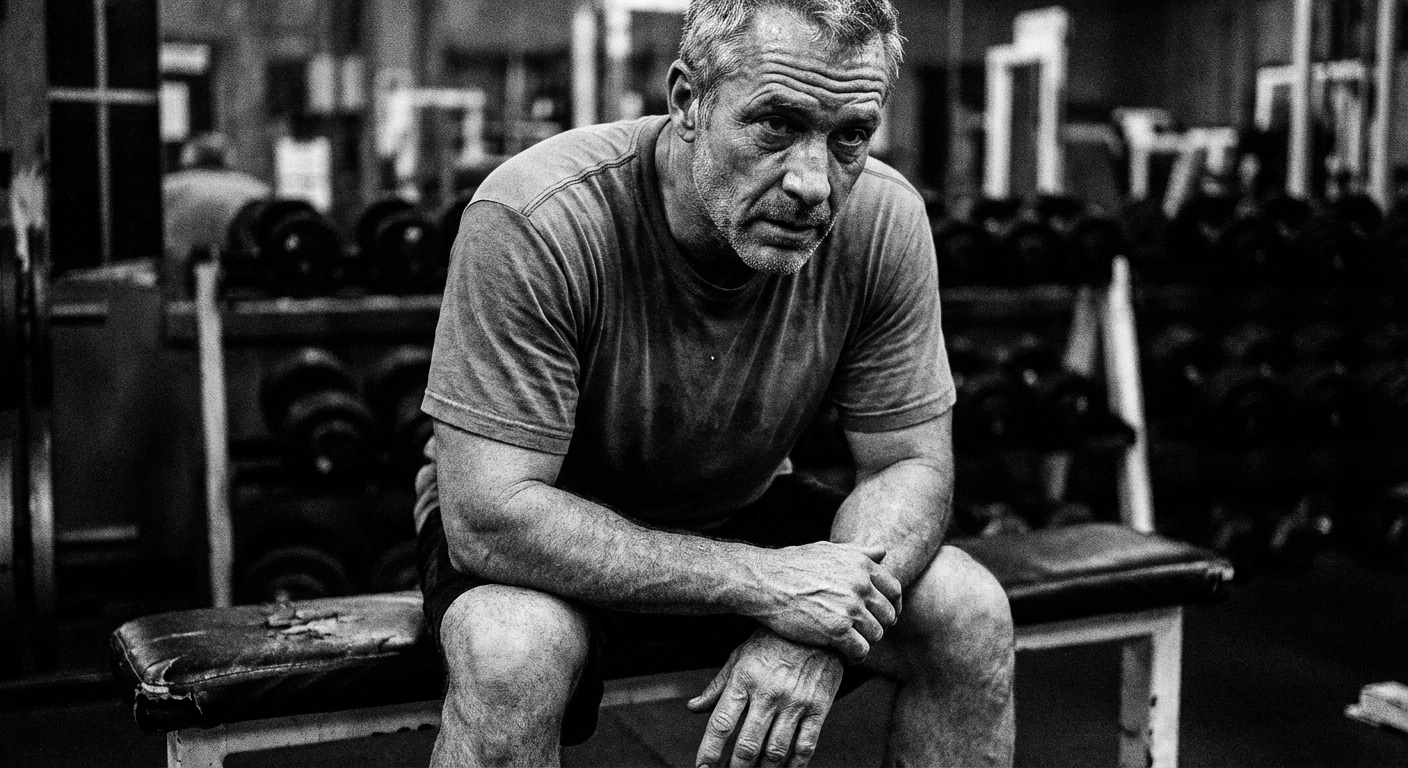
You trained hard yesterday. Your legs feel like concrete and getting off the couch takes more effort than the workout itself. That soreness lasting three or four days instead of one or two — it's not in your head. Recovery genuinely slows after 40, and for reasons that are well understood by science.
The good news: once you know why recovery takes longer, you can do something about it. These 12 muscle recovery tips for men over 40 are drawn from peer-reviewed research, not gym mythology. Apply them systematically and you'll recover faster, train more consistently, and build more muscle than men half your age who ignore recovery entirely.
Why Muscle Recovery Slows After 40
Three biological shifts explain most of the change.
Satellite cell delay. Satellite cells are your muscle's dedicated repair crew — stem cells that activate after damage, proliferate, and fuse into injured fibers. Research published in Biology (Basel) found that in younger men, satellite cell activation peaks around 48 hours post-exercise. In men over 40, that same peak is delayed to 72 hours. Recovery takes longer because the repair process itself starts later.
Hormonal decline. Testosterone drops roughly 1-2% per year after 30. Growth hormone — released in pulses during deep sleep — also declines as deep sleep quality degrades with age. Both hormones directly fuel muscle protein synthesis and satellite cell function. Lower levels mean slower repair.
Inflammaging. Geroscientists use this term for the chronic, low-grade inflammation that accumulates with aging. With elevated baseline levels of inflammatory cytokines (TNF-α, IL-6), your body struggles to distinguish "acute exercise damage that needs repair" from background noise. The repair signal gets muted.
Anabolic resistance. Older muscle tissue requires more protein stimulus to achieve the same muscle protein synthesis response. A 2024 review in Frontiers in Nutrition found young men need around 20g of high-quality protein to maximally stimulate muscle building, while men over 60 need roughly 40g for the same effect.
Understanding these mechanisms matters because each recovery tip below targets one or more of them directly.
The 12 Recovery Tips
1. Treat Sleep as Your Primary Recovery Tool
Nothing else on this list matters if you aren't sleeping. Growth hormone — the primary anabolic recovery signal — releases almost entirely during slow-wave sleep in the early part of the night. A 2021 study in Physiological Reports found a single night of total sleep deprivation reduced post-exercise muscle protein synthesis by 18%, dropped testosterone by 24%, and elevated cortisol by 21%. One bad night undoes a strong training session.
Target 7-9 hours. Keep your bedroom at 65-68°F (18-20°C) — your core temperature must drop approximately 2°F to enter deep sleep. Alcohol after 6pm suppresses slow-wave sleep by around 25% even if you don't feel its effects the next morning. A consistent sleep and wake time matters more than total hours for deep sleep quality.
For strategies on improving sleep quality specifically, see how to improve sleep quality for men over 40.
2. Eat More Protein Than You Think You Need
Because of anabolic resistance, the protein targets that worked at 25 fall short after 40. The International Society of Sports Nutrition recommends 1.4-2.0g of protein per kilogram of bodyweight daily for exercising individuals. For men over 40, aim for the upper end: 0.8-1.0g per pound of bodyweight (1.8-2.2g/kg).
Equally important is distribution. Spreading protein across 3-4 meals produces better muscle protein synthesis than front- or back-loading the same total amount. Aim for 35-40g per meal — enough to clear the leucine threshold and trigger mTORC1 signaling in older muscle tissue.
Pre-sleep protein warrants special mention. Multiple randomized controlled trials published in Nutrients show that 40g of casein protein before bed increases overnight muscle protein synthesis in older men. If you're in a deficit or training hard, this is one of the highest-leverage additions you can make.
3. Master the 48-to-72-Hour Rule
The single most impactful structural change most men over 40 can make to their training: stop working the same muscle group within 48 hours of the previous session.
Young men can train the same muscles every 48 hours with full recovery. Men over 40 need 48-72 hours minimum between sessions targeting the same groups. This is a biological reality, not a preference. Research from Experimental Gerontology confirms the difference directly.
This doesn't mean training less overall — it means distributing volume more intelligently. An upper/lower split or push/pull/legs structure naturally accommodates longer recovery windows. See the full body workout routine for men over 50 for a program designed around this principle.
4. Use Active Recovery — Not Complete Rest
On the day after a hard session, your instinct might be to do nothing. Passive rest is often inferior to light movement for recovery outcomes.
Low-intensity aerobic activity at 30-40% of your VO2 max — walking, easy cycling, swimming — enhances blood flow to recovering tissue and clears metabolic waste without adding training stress. It also maintains GLUT-4 upregulation, which improves nutrient delivery to muscles actively repairing themselves.
Twenty to thirty minutes at a genuinely easy pace is enough. If you're panting or breaking a real sweat, you're working too hard. Think of active recovery as a delivery service for the protein and nutrients you've already consumed.
5. Dial In Your Post-Workout Nutrition Window
The idea of a narrow 30-minute anabolic window has been overstated. A meta-analysis in the Journal of the International Society of Sports Nutrition showed that consuming protein within 2 hours of training produces equivalent muscle protein synthesis outcomes. You have more time than the supplement industry would like you to believe.
What matters more than timing precision: actually consuming a substantial meal with 35-40g of protein and adequate carbohydrate within that two-hour window. Carbohydrates replenish muscle glycogen and blunt cortisol, the stress hormone that remains elevated after hard training. A 3:1 or 4:1 carb-to-protein ratio is well-supported for post-workout recovery nutrition.
6. Add Cold Water Immersion Strategically
Cold water immersion works — but with important caveats.
A 2025 network meta-analysis published in Frontiers in Physiology identified the optimal cold immersion protocol: water temperature between 11-15°C (52-59°F) for 11-15 minutes. This combination produced the greatest reduction in delayed onset muscle soreness (DOMS) and the greatest drop in creatine kinase, a blood marker of muscle damage.
The caveat: a 2024 systematic review in European Journal of Sport Science found that regular cold water immersion blunts long-term hypertrophy by interfering with the inflammatory signaling required for muscle adaptation. Cold therapy suppresses the very process that makes you stronger.
Use it strategically. When recovery speed matters more than maximizing muscle growth — before an important event, during a high-frequency training block, or when you simply need to function tomorrow — cold immersion is a powerful tool. Don't use it after every session if building muscle is your primary goal.
7. Consider Heat Therapy for Routine Recovery
Where cold immersion blunts inflammation, heat therapy works through different mechanisms: improved circulation, metabolic waste clearance, and upregulation of heat shock proteins that support cellular repair.
An RCT published in PMC10286597 found post-training infrared sauna sessions improved neuromuscular performance recovery and reduced muscle soreness compared to passive rest. Importantly, unlike cold therapy, heat does not appear to blunt hypertrophy — and some research suggests it may actually support it.
Protocol: 15-20 minutes at 80-90°C in a Finnish dry sauna, or 40-50°C in an infrared sauna, 2-4 times per week. A Finnish study also found a single sauna session dropped cortisol from 13.61 to 9.67 µg/ml — a meaningful 29% reduction.
8. Foam Roll for Function, Not Pain Relief
Foam rolling doesn't significantly reduce pain perception. What it does do is accelerate the return of muscle contractile function — and that's what matters for training frequency.
The foundational study (published in Journal of Athletic Training) tested 20 minutes of foam rolling immediately post-exercise and at 24 and 48 hours. Compared to no rolling, foam rolling groups showed 88 kPa less tenderness at 24 hours and 140 kPa improvement at 48 hours. Sprint speed was 0.06 seconds faster at 24 hours and 0.08 seconds faster at 72 hours. That functional recovery edge allows you to train again sooner without compromising performance.
A 2025 review in Journal of Functional Morphology and Kinesiology found 90-120 seconds per muscle group is the effective dose for flexibility and recovery benefits. Spend more time than that and you're not adding meaningful benefit.
Percussive massage devices (massage guns) produce a similar profile — useful for fascial release and blood flow, with the convenience advantage of speed and targeted access.
9. Monitor Heart Rate Variability
Heart rate variability (HRV) measures the variation in time between consecutive heartbeats. Higher HRV indicates a nervous system operating in parasympathetic (recovery) mode. Lower HRV signals residual stress, incomplete recovery, or early-stage overtraining.
Research published in Journal of Strength and Conditioning Research (2024) validated HRV as a non-invasive biomarker for training readiness in experienced athletes. An HRV-guided training study in Scientific Reports (2025) found that athletes who adjusted workout intensity based on morning HRV outperformed those following fixed programming.
Practical use: measure resting HRV immediately upon waking, before coffee, before standing. Track the 7-day rolling average — not individual readings, which fluctuate too much to be meaningful. When your morning HRV drops more than 10% below your rolling baseline, reduce training intensity or take an active recovery day. Three consecutive low readings warrant a full deload.
Apps that make this accessible: HRV4Training (camera-based, no wearable needed), Elite HRV, WHOOP, Garmin Fenix, or Apple Watch with the Cardiogram app.
10. Schedule Deload Weeks Every 3-4 Weeks
A deload is a planned reduction in training load — not a rest week, but a week where volume drops 40-60% and intensity drops 20-40%. The nervous system and connective tissue get a break while training frequency is maintained.
Expert consensus from Sports Medicine Open recommends deloads every 4-6 weeks for most athletes. For men over 40, with longer recovery windows and higher baseline fatigue accumulation, every 3-4 weeks is more appropriate. Your body needs the reset more frequently, not less.
Deloads preserve neuromuscular adaptations while allowing accumulated fatigue to dissipate. The week after a proper deload consistently produces personal bests. The week before it — when you're maximal in accumulated fatigue — rarely does.
Planned deloads also serve as injury prevention. Most overuse injuries in men over 40 develop during periods of sustained high load without adequate recovery. Building the deload into your program removes that accumulation before it becomes structural damage.
For the broader picture of how to build muscle after 40 naturally, deload programming is covered in more detail.
11. Add These Three Recovery Supplements
Most supplements don't survive scrutiny. These three have consistent evidence behind them specifically for recovery.
Creatine monohydrate has the strongest evidence base of any ergogenic supplement for men over 40. Multiple meta-analyses confirm that creatine combined with resistance training produces significantly greater lean mass and strength gains in older adults than training alone. It also attenuates post-exercise inflammatory markers, supporting recovery directly. Dose: 3-5g daily. No loading phase required; it saturates over 4 weeks rather than 1.
Omega-3 fatty acids (EPA + DHA) reduce the prostaglandin E2 and leukotriene B4 that drive exercise-induced muscle inflammation. A meta-analysis in BioMed Research International found meaningful reductions in DOMS with approximately 2,145mg EPA and 858mg DHA daily — roughly 3g of combined EPA+DHA. The effect is most pronounced in men who are new to or returning to training.
Magnesium glycinate supports both muscle recovery and sleep quality. A 2024 study in Journal of Translational Medicine found magnesium supplementation reduced muscle soreness and had a protective effect on muscle damage markers in physically active men. A 2025 RCT (PMC12412596) showed magnesium glycinate improved sleep efficiency and nighttime awakenings — delivering the dual benefit of better sleep and faster tissue repair. Dose: 400-420mg elemental magnesium daily.
For a comprehensive breakdown of supplementation for men over 40, including dosages and what to avoid, see the magnesium supplement benefits guide.
12. Recognize Overtraining Before It Requires Months to Fix
Overtraining syndrome is distinct from normal post-workout fatigue, and the distinction matters. Normal fatigue resolves in 1-2 days. Overtraining syndrome can take 2-3 months — or longer — to fully resolve.
Early warning signs to act on immediately:
- Performance decline across two consecutive sessions on exercises you handle routinely
- Resting heart rate elevation of 5-10 BPM above your baseline for three or more consecutive days
- DOMS lasting beyond 72 hours after training that would normally cause 24-48 hours of soreness
- Sleep disruption — difficulty falling asleep or waking early, despite physical tiredness
- Mood changes — irritability, anxiety, or persistent low mood from HPA axis dysregulation
- Reduced libido — a direct effect of the testosterone-to-cortisol imbalance that accompanies overtraining
- Frequent illness — chronic cortisol elevation suppresses immune function
If you hit multiple signs simultaneously, take a full deload week immediately. If symptoms persist beyond 2 weeks of reduced load, consider getting bloodwork: total testosterone, free testosterone, SHBG, and a morning cortisol draw. Low testosterone in the presence of training stress warrants a conversation with your doctor.
For reference on what low testosterone looks like and when testing makes sense, see how to get your testosterone levels checked and 10 signs of low testosterone in men over 40.
Putting It Together: A Weekly Recovery Framework
Applying 12 tips simultaneously is overwhelming. Here's a practical weekly structure that integrates the most impactful ones:
Every training day:
- Consume 35-40g protein within 2 hours post-workout
- 90-120 seconds of foam rolling per trained muscle group
- 40g casein protein before sleep (or any slow-digesting protein source)
Every day:
- 7-9 hours sleep with consistent bedtime
- 0.8-1.0g protein per pound of bodyweight distributed across meals
- 3-5g creatine monohydrate
- ~3g EPA+DHA omega-3s
- 400mg magnesium glycinate before bed
Recovery days (between training sessions):
- 20-30 minutes easy walking, cycling, or swimming
- 15-20 minute sauna session if available
Weekly:
- Track morning HRV daily; act on readings 10%+ below 7-day average
- Every 3-4 weeks: scheduled deload week
Frequently Asked Questions
How long should muscle soreness last after 40? Expect 48-72 hours of soreness after intense or novel training — that's normal and reflects active satellite cell repair. Soreness consistently lasting beyond 72 hours is a signal to reduce training volume, improve sleep, or increase protein intake. It rarely means you've done lasting damage, but it does mean recovery is incomplete.
Is cold plunging good or bad for muscle recovery after 40? Both. Cold water immersion (11-15°C for 11-15 minutes) reduces DOMS and speeds functional recovery. But used regularly, it blunts the inflammatory signaling needed for muscle adaptation and long-term hypertrophy. Use it strategically — before events where you need to perform again quickly — not habitually after every session.
Can I build muscle if I'm always sore? Persistent soreness typically means you're not recovering between sessions, which limits the anabolic stimulus of each workout. Reduce volume, prioritize sleep and protein, and add active recovery days. Muscle builds during recovery, not during training itself.
Should I train if I'm still sore from the previous session? Light movement on sore muscles — active recovery — is generally beneficial. Training the same muscle group at full intensity while still significantly sore risks compounding damage and reducing workout quality. Train a different muscle group, or drop intensity to 50% if you must work the same area.
What's the fastest way to recover from a hard leg workout? In order of impact: sleep 8+ hours that night, consume 40g protein within 2 hours post-workout, do a 15-minute easy walk the next morning, spend 90 seconds foam rolling each muscle group, and consider a 12-minute cold immersion at around 13°C if you need to train again within 48 hours.
How important is hydration for recovery? More important than most men recognize. A 2% drop in bodyweight from fluid loss measurably impairs muscle performance and delays recovery. For post-workout rehydration, replace 150% of fluid lost — if you lost 1kg of sweat, drink 1.5L of fluid with electrolytes (sodium, potassium, magnesium). Water alone is inadequate for full rehydration.
Always consult your healthcare provider before starting any new exercise or supplement program, particularly if you have pre-existing medical conditions or are taking medications.
Medical Disclaimer: This article is for informational purposes only and does not constitute medical advice. Always consult your healthcare provider before starting any new exercise, nutrition, or supplement program.