Lower back pain is the single leading cause of disability worldwide, according to the Global Burden of Disease Study — and men in their 40s and 50s carry a disproportionate share of it. Desk jobs, decades of poor movement patterns, muscle loss that accelerates after 35, and natural disc degeneration all converge at exactly the age when most men start noticing that getting off the floor takes a moment of planning.
The good news: a 2018 systematic review published in The Lancet found that exercise is the most effective long-term treatment for non-specific lower back pain — outperforming opioids, passive therapies, and even surgery for most cases. Ten minutes a day, done consistently, changes the trajectory.
This routine targets the root causes, not just the symptoms.
Why Lower Back Pain Gets Worse After 40
Before the exercises, the mechanism matters. Understanding why backs degrade helps you choose movements that actually fix things rather than temporarily suppress pain.
Muscle atrophy. Sarcopenia — the age-related loss of muscle mass — begins around age 35 and accelerates through the 40s. The muscles that support the lumbar spine (multifidus, erector spinae, transverse abdominis) weaken, leaving the discs and ligaments to absorb forces they were never designed to handle alone.
Disc dehydration. Intervertebral discs lose water content with age. A healthy disc acts as a shock absorber; a dehydrated one compresses under load and transmits force directly to the vertebrae and surrounding nerves. MRI studies show measurable disc height loss beginning in the fourth decade.
Hip flexor tightness. Men who sit for work develop chronically shortened hip flexors. Tight hip flexors pull the pelvis into anterior tilt, exaggerating lumbar curvature and compressing the facet joints in the lower spine. This is one of the most correctable contributors to back pain, and it responds well to daily stretching.
Glute inhibition. Sitting switches off the glutes. Weak glutes force the lower back to pick up the load during hip extension movements — walking, climbing stairs, bending — creating cumulative strain at L4-L5 and L5-S1, the most common sites for disc herniation.
Reduced movement variety. Younger bodies move through full ranges of motion naturally. Men over 40 who exercise tend to repeat the same patterns (running, lifting, cycling) without the mobilization work that keeps spinal joints lubricated and neural pathways primed.
The 10-Minute Daily Relief Routine
Do this every morning, before your spine has loaded up from a day of sitting and standing. Seven movements. No equipment. Start each session gently — the goal for the first two minutes is movement, not stretch intensity.
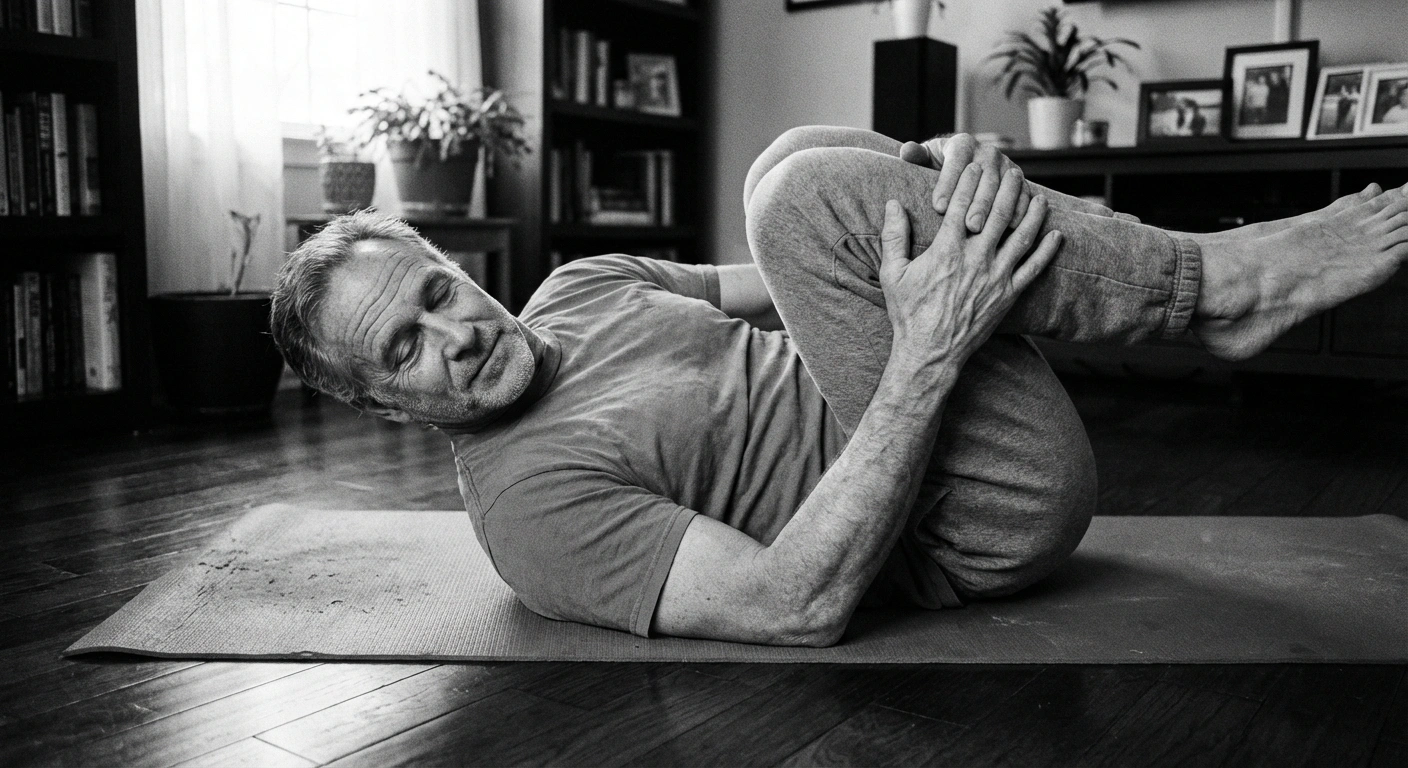
1. Knee-to-Chest Stretch (60 seconds per side)
Lie on your back on a firm surface. Pull one knee toward your chest using both hands, keeping the other leg extended. Hold for 30 seconds, then switch.
This decompresses the lumbar vertebrae and lengthens the erector spinae. A 2020 study in the Journal of Physical Therapy Science documented significant reductions in lower back pain intensity after four weeks of daily knee-to-chest stretching in adults over 40.
Cue: Keep your lower back flat against the floor. If it arches, bend the extended leg.
2. Cat-Cow Mobilization (90 seconds, 10 slow repetitions)
Start on hands and knees, wrists under shoulders, knees under hips. Inhale as you drop your belly toward the floor and lift your head (cow position). Exhale as you round your spine toward the ceiling and tuck your chin (cat position). Move slowly — each rep takes about 8 seconds.
Cat-cow moves the lumbar spine through its full flexion-extension range, pumping synovial fluid into the facet joints and restoring segmental mobility. Physical therapists use this as first-line treatment for stiff, painful spines for good reason.
Cue: The movement comes from the spine, not from pressing through the arms. Keep your arms straight and let your back do the work.
3. Child's Pose with Lateral Reach (60 seconds per side)
From hands and knees, push your hips back toward your heels and lower your forehead toward the floor. Walk your hands to the right to create a lateral stretch through the left side of your back. Hold 30 seconds. Return to center, then walk hands left.
This stretches the quadratus lumborum — a deep muscle that, when tight, is one of the most common sources of sharp unilateral lower back pain. Most men have never heard of it.
Cue: Breathe into the side that is stretching. Feel the ribs expand and the tension shift.
4. Pelvic Tilt (60 seconds, 15 repetitions)
Lie on your back, knees bent, feet flat. Flatten your lower back against the floor by contracting your abdominals — not by pushing with your legs. Hold for 3 seconds, then release. Repeat.
The pelvic tilt reactivates the transverse abdominis (the deep core stabilizer that switches off in men with chronic back pain) and teaches posterior pelvic rotation, which counteracts the anterior tilt caused by tight hip flexors.
Cue: Think about drawing your navel toward your spine. There is no visible movement from the outside — it is entirely internal.
5. Bird Dog (90 seconds, 8 repetitions per side)
On hands and knees, extend your right arm forward and left leg back simultaneously, keeping your spine neutral (no rotation, no hip drop). Hold for 3 seconds. Return and switch sides.
Bird dog is one of the most validated lower back exercises in the rehabilitation literature. Research published in Archives of Physical Medicine and Rehabilitation confirmed that bird dog exercise significantly improves lumbar stability and reduces pain scores in adults with chronic low back pain. It trains the multifidus — the small segmental muscle that is the first to atrophy in people with back problems.
Cue: Imagine balancing a glass of water on your lower back. If it would spill, you are rotating. Adjust until it wouldn't.
6. Glute Bridge (90 seconds, 12 repetitions)
Lie on your back, knees bent, feet hip-width apart. Press through your heels and lift your hips until your body forms a straight line from knees to shoulders. Squeeze your glutes at the top. Hold for 2 seconds, lower slowly, and repeat.
Glute bridges strengthen the gluteus maximus and medius, restoring the hip extension function that your lower back has been compensating for. A 2019 study in PM&R found that glute bridge training reduced lower back pain intensity by 37% in sedentary men after six weeks.
Cue: Drive through your heels, not your toes. Feel your glutes working, not your hamstrings or lower back. If your back is doing the work, drop your hips two inches lower.
7. Piriformis Stretch — Figure Four (60 seconds per side)
Lie on your back. Cross your right ankle over your left knee, creating a figure-four shape. Flex your right foot (toes toward your shin). Either stay here or pull your left thigh toward your chest to deepen the stretch. Hold 30 seconds, then switch.
The piriformis sits deep in the gluteal region and, when tight, compresses the sciatic nerve — producing the radiating pain that runs down the back of the leg. This is commonly misdiagnosed as a disc problem. Men who sit for extended periods develop chronically tight piriformis muscles.
Cue: The stretch sensation should be in the back of the hip, not the front. If you feel it in your knee, flex your ankle more firmly.
After the Routine: Building Lasting Strength
The 10-minute routine manages pain and restores mobility. Lasting spinal resilience requires strength work three to four days per week.
The three most important exercises for a strong lower back:
Deadlifts — When performed with proper technique, the hip-hinge pattern in a deadlift strengthens every muscle in the posterior chain (glutes, hamstrings, erectors) in an integrated pattern. Start with Romanian deadlifts using light weight and master the hip hinge before adding load. If you are working around knee issues as well, see the modifications in 15 Low Impact Exercises for Men with Bad Knees.
Farmers carries — Walking with weight in each hand forces the core and spine to resist lateral flexion under load. This trains the quadratus lumborum (the muscle you stretched in child's pose) as a stabilizer rather than a pain generator.
Rowing movements — Horizontal pulling exercises (cable rows, dumbbell rows, TRX rows) strengthen the thoracic extensors, which reduces the compensatory load on the lumbar spine. Men who have strong upper backs rarely develop chronic lower back pain.
For a complete program structure, the Full Body Workout Routine for Men Over 50 includes these movements with appropriate progressions for older trainees.
Recovery and Sleep
Pain recurrence correlates strongly with poor sleep. Deep sleep is when the body repairs musculoskeletal tissue, consolidates motor patterns, and reduces systemic inflammation — all critical for men managing back pain.
Men who sleep less than six hours per night have measurably higher inflammatory markers (IL-6, CRP), which amplifies pain sensitivity throughout the nervous system. Improving sleep quality directly reduces the perception of pain intensity.
Specific strategies for men with back pain: sleep on your side with a pillow between the knees (maintains spinal alignment), or on your back with a pillow under the knees (reduces lumbar extension). Stomach sleeping increases lumbar compression and should be avoided. For detailed sleep strategies, How to Improve Sleep Quality for Men Over 40 covers the full protocol.
Supplements That Support Spinal Health
Supplements do not fix structural problems, but several address underlying contributors to back pain.
Magnesium reduces muscle tension and improves sleep quality — both directly relevant to back pain management. Most men over 40 are deficient. The evidence for magnesium in musculoskeletal health is reviewed in Magnesium Supplement Benefits for Men.
Collagen peptides with vitamin C support connective tissue (discs, ligaments, tendons) repair. Research in British Journal of Nutrition confirmed that collagen supplementation combined with loading exercise increases connective tissue synthesis.
Omega-3 fatty acids reduce prostaglandin-mediated inflammation in spinal tissues. A dose of 2-3 grams EPA+DHA per day shows measurable anti-inflammatory effects in musculoskeletal conditions.
For men with related joint issues beyond the spine, Best Joint Supplements for Men Over 50 compares the most evidence-backed options.
What to Avoid
Certain common behaviors accelerate back pain rather than resolve it.
Prolonged bed rest. A 2004 Cochrane review confirmed that bed rest is harmful for most lower back pain conditions — it decelerates recovery compared to staying active. Move gently, even when it is uncomfortable.
Sit-ups and crunches. These exercises create high compressive loads on the lumbar discs (research by Stuart McGill at the University of Waterloo quantified this at six times body weight at L4-L5 during a full sit-up). They also do not train the deep stabilizers that back pain patients need.
Heat on acute injuries. During the first 48-72 hours of an acute flare, ice reduces inflammation more effectively. Heat is appropriate for chronic stiffness and muscle tension, not acute tissue damage.
Ignoring hip mobility work. Many men stretch their hamstrings when their hips are the actual limitation. If you cannot touch your toes without rounding your lower back, the restriction is usually hip flexion, not hamstring length.
When to See a Doctor
Most lower back pain responds to conservative treatment within 4-6 weeks. See a physician promptly if you experience:
- Pain radiating down one leg below the knee, combined with numbness or tingling (nerve compression sign)
- Loss of bladder or bowel control (emergency — can indicate cauda equina syndrome)
- Back pain following a fall, accident, or significant trauma
- Pain that worsens at night, even when lying still
- Unexplained weight loss alongside back pain
- Pain that does not improve after 6 weeks of consistent conservative treatment
Do not self-diagnose disc herniation or spinal stenosis from symptoms alone — both are definitively diagnosed with MRI and require clinical interpretation. The routine above is appropriate for non-specific lower back pain, the category that accounts for approximately 90% of all cases.
Frequently Asked Questions
How long before the exercises reduce my pain?
Most men notice reduced stiffness within the first week. Measurable pain reduction typically appears at 2-3 weeks of consistent daily practice. The structural strengthening gains that provide lasting protection take 6-8 weeks.
Should I exercise when my back is in acute pain?
Gentle movement — particularly cat-cow, knee-to-chest, and pelvic tilts — is beneficial even during a flare. Skip bird dog and glute bridges during acute episodes, as these require more stability. Avoid complete rest.
Is lower back pain normal at 45?
Common, yes. Normal, no. Back pain in the 40s typically signals correctable problems — weak glutes, tight hip flexors, insufficient core stability — not irreversible aging. Men who address these with consistent exercise frequently eliminate pain entirely.
Can I do this routine before lifting weights?
The routine works as a warm-up before strength training, particularly the cat-cow and glute bridge movements. Bird dog as a pre-lift primer activates the multifidus and improves stability for loaded movements.
What about professional treatment?
A sports medicine physician or physical therapist can assess whether your pain has a specific structural cause (disc, facet, SI joint) and tailor treatment accordingly. The exercises here address the most common contributors, but a proper evaluation eliminates guesswork.
Will this help with sciatica?
The piriformis stretch and knee-to-chest stretch often reduce sciatic symptoms caused by piriformis syndrome or mild disc bulging. Severe sciatica — especially with neurological symptoms like numbness or weakness — warrants medical evaluation before starting a new exercise program.
Key Takeaways
- Lower back pain in men over 40 is driven by muscle weakness, hip flexor tightness, and disc dehydration — all addressable with targeted exercise
- The 10-minute daily routine covers all primary contributors: spinal mobility, deep core activation, glute strengthening, and hip flexor release
- Cat-cow, bird dog, and glute bridge are the three highest-return exercises for long-term back health
- Strength training three days per week, particularly deadlifts and rows, builds the structural resilience that prevents recurrence
- Persistent pain, neurological symptoms, or trauma warrants medical evaluation before continuing exercise
Consult your healthcare provider before starting any new exercise program, particularly if you have a diagnosed spinal condition, recent surgery, or pain that radiates below the knee.
Medical Disclaimer: This article is for informational purposes only and does not constitute medical advice. Always consult your healthcare provider before starting any new exercise, nutrition, or supplement program.