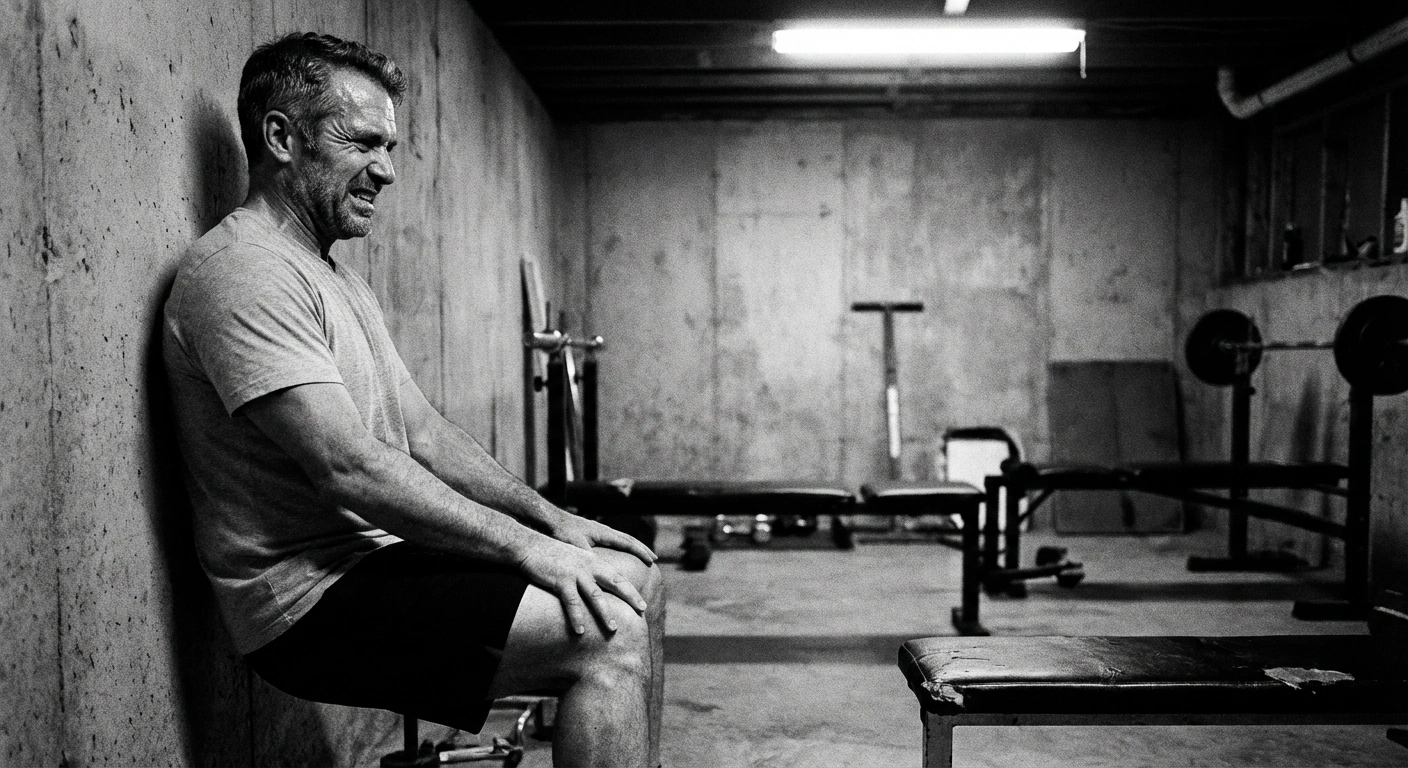
Bad knees do not mean the end of training. If you are a man over 40 dealing with knee pain, arthritis, or old injuries, you need low impact exercises for men with bad knees that build strength and cardiovascular fitness without grinding your joints into dust. The right exercises protect your knees while making the surrounding muscles stronger, which reduces pain over time.
A 2022 systematic review and meta-analysis published in Frontiers in Physiology confirmed that land-based exercise programs produce significant improvements in pain, stiffness, and physical function for people with knee osteoarthritis. The American College of Sports Medicine (ACSM) recommends at least two resistance training sessions per week alongside regular cardio for anyone managing joint issues.
The 15 exercises below are divided into three categories: strength, cardio, and mobility. Each one earned its place because research supports it, and because men with knee problems can do it without waking up the next morning regretting their decisions.
Strength Exercises for Bad Knees
Building muscle around your knees is the single best long-term strategy for reducing joint pain. Stronger quadriceps, hamstrings, and glutes absorb forces that would otherwise hammer your cartilage. A study in the Journal of Physical Therapy Science found that quadriceps strengthening exercises improved pain, function, and quality of life in patients with knee osteoarthritis.
These six exercises strengthen the muscles surrounding your knee while keeping joint stress low. If you are following a strength training program for men over 40, swap in these movements on days when your knees need a break.
1. Wall Sits
What it is: You lean your back flat against a wall and slide down until your thighs reach roughly parallel to the floor. Then you hold.
Why it works for bad knees: Wall sits are an isometric exercise. Your knee joint stays in a fixed position with no repetitive bending or shearing force. The quadriceps do all the work while the knee stays stable. You control the depth. If parallel is too aggressive, slide down only halfway.
How to do it:
- Stand with your back flat against a wall, feet shoulder-width apart and about 18 inches from the wall.
- Slide down until your thighs reach a comfortable angle (start at 45 degrees, progress toward parallel).
- Keep your knees tracking over your toes, not caving inward.
- Hold the position. Breathe.
Sets/reps: 3 holds of 20-45 seconds. Rest 60 seconds between holds. Add 5 seconds per week.
2. Leg Press with Limited Range of Motion
What it is: A machine-based pressing movement where you push a weighted sled away from your body using your legs. Limiting the range of motion keeps the knee from bending past the point where it hurts.
Why it works for bad knees: The leg press removes spinal loading and lets you control exactly how deep you bend. Most knee pain during squatting happens at deep flexion angles beyond 90 degrees. By setting the seat position so your knees never pass 90 degrees, you train your quads and glutes through a pain-free range.
How to do it:
- Sit in the leg press with your back flat against the pad.
- Place feet shoulder-width apart, positioned high on the footplate (this shifts stress from knees to glutes).
- Lower the sled until your knees reach about 90 degrees of flexion, no deeper.
- Press back up without locking out your knees at the top.
Sets/reps: 3 sets of 10-12 reps. Use moderate weight. This is not the exercise for ego lifting.
3. Hip Bridges (Glute Bridges)
What it is: Lying on your back, you drive your hips toward the ceiling by squeezing your glutes. Your feet stay flat on the floor.
Why it works for bad knees: Your knees barely move during a hip bridge. The movement happens almost entirely at the hip joint. Yet it builds the glutes and hamstrings, both of which stabilize the knee from behind. Weak glutes are a common contributor to knee pain because the knee compensates for hip instability.
How to do it:
- Lie face-up on the floor. Bend your knees to about 90 degrees, feet flat and hip-width apart.
- Drive through your heels and squeeze your glutes to lift your hips until your body forms a straight line from shoulders to knees.
- Hold the top position for 2 seconds.
- Lower under control.
Sets/reps: 3 sets of 12-15 reps. Progress to single-leg bridges when bodyweight becomes too easy.
4. Step-Ups on a Low Box
What it is: You step onto a low platform (4-8 inches) with one foot, drive up to standing, then step back down. Keep the box low to limit knee flexion.
Why it works for bad knees: Step-ups train each leg independently, which corrects strength imbalances that often contribute to knee pain. The low box height means your knee never bends past a comfortable range. The movement also mimics real life. Climbing stairs, getting into a truck, stepping over obstacles.
How to do it:
- Stand facing a sturdy box or step (start at 4-6 inches).
- Place your entire foot on the box. Do not let your heel hang off.
- Push through the working leg to stand up fully on the box.
- Lower yourself slowly back to the floor. Control the descent.
Sets/reps: 3 sets of 8-10 reps per leg. Add height gradually. If 8 inches causes no pain, try 10.
5. Resistance Band Lateral Walks
What it is: With a resistance band looped around your ankles or just above your knees, you take controlled steps sideways while maintaining a partial squat position.
Why it works for bad knees: Lateral band walks target the gluteus medius, a hip muscle that controls frontal-plane stability. A 2025 narrative review in Frontiers in Physiology found that lateral band walks enhance frontal-plane control and reduce excessive knee valgus, a common contributor to patellofemoral pain. Weak hip abductors force the knee to absorb rotational forces it was not built to handle.
How to do it:
- Place a resistance band just above your knees (easier) or around your ankles (harder).
- Stand in a quarter-squat position, feet shoulder-width apart.
- Take 10-15 controlled steps to the right, keeping tension on the band.
- Repeat to the left.
Sets/reps: 3 sets of 15 steps in each direction. Use a band that makes the last 3-4 steps challenging.
6. Seated Leg Extensions (Light Weight, Partial Range)
What it is: Using a leg extension machine, you extend your lower leg against a padded resistance from a seated position.
Why it works for bad knees: When done correctly with light weight and a limited range, seated leg extensions isolate the quadriceps without loading the knee joint with your body weight. The key modification: avoid the last 30 degrees of extension if you have patellofemoral pain, and never use heavy weight. This is a quad activation exercise, not a max-effort lift.
How to do it:
- Sit in the leg extension machine with your back firmly against the pad.
- Adjust the pad so it rests on your lower shins, just above the ankle.
- Extend your legs from 90 degrees to about 45 degrees of flexion. Do not lock out fully.
- Lower under control for a count of 3.
Sets/reps: 3 sets of 15 reps with light weight. If you feel grinding or sharp pain, reduce the range further or skip this exercise.
Cardio Exercises for Bad Knees
Cardiovascular fitness matters for knee health in ways most men overlook. Excess body weight puts enormous stress on knee joints. Every pound of body weight translates to roughly 4 pounds of force on the knee during walking, according to the Arthritis Foundation. Cardio burns calories, improves circulation to joint tissues, and promotes the production of synovial fluid, your knee's natural lubricant.
These five joint-friendly exercises deliver serious cardio training without pounding your knees. If you are interested in the longevity benefits of lower-intensity cardio, read our guide on zone 2 cardio and its benefits for longevity.
7. Swimming and Pool Walking
What it is: Swimming laps or walking in chest-deep water. The buoyancy of water reduces your effective body weight by about 90%, making it one of the most knee-friendly exercises available.
Why it works for bad knees: A 2022 systematic review in BMC Musculoskeletal Disorders found that aquatic exercise yields significant improvements in pain, stiffness, and physical function in people with knee osteoarthritis, with no serious adverse events reported across any included study. Water provides natural resistance in all directions, so you build strength while getting your heart rate up. Pool walking is the gateway for men who have not exercised in months due to knee pain.
How to do it:
- Swimming: Start with breaststroke or freestyle for 10-15 minutes. Use a pull buoy between your legs to eliminate the kick if kicking causes knee discomfort.
- Pool walking: Walk laps in chest-deep water. The water's resistance makes this far more demanding than it sounds. Add hand paddles or aqua dumbbells for extra resistance.
Duration: 20-40 minutes, 2-3 times per week.
8. Stationary Bike or Outdoor Cycling
What it is: Pedaling on a stationary bike or road bike at moderate resistance.
Why it works for bad knees: Cycling is the gold standard of knee-friendly cardio. A large-scale study involving over 2,600 adults found that regular cyclists were 17% less prone to knee pain and 21% less likely to show radiographic signs of osteoarthritis. Cycling strengthens the quadriceps and hamstrings through a smooth, circular motion with zero impact. It also stimulates synovial fluid production, which lubricates the joint and reduces stiffness.
How to do it:
- Set the seat height so your knee bends only slightly (about 25-30 degrees) at the bottom of the pedal stroke.
- Start with low resistance. You should be able to maintain 70-80 RPM comfortably.
- Push down and pull up through the full pedal revolution to balance quad and hamstring engagement.
- Avoid high resistance settings that force you to grind the pedals slowly.
Duration: 20-45 minutes, 3-5 times per week. Start at the low end and add 5 minutes per week.
9. Elliptical Trainer
What it is: A machine that simulates walking or running with a gliding, low-impact foot motion. Your feet never leave the pedals.
Why it works for bad knees: Research published in Gait & Posture found that elliptical training produces lower peak tibial forces than jogging while providing comparable cardiovascular benefits. Because your feet remain on the pedals throughout the motion, there is no footstrike impact. A 2021 study found that participants with mild-to-moderate knee osteoarthritis reported significantly less pain during and after elliptical use compared to treadmill walking.
How to do it:
- Start with low resistance and a moderate stride length.
- Keep your posture upright. Do not lean on the handrails.
- Maintain a pace of 120-140 strides per minute for moderate-intensity cardio.
- Use the moving handles to engage your upper body and share the workload.
Duration: 20-30 minutes, 3-4 times per week.
10. Rowing Machine
What it is: A machine that simulates the motion of rowing a boat. You sit on a sliding seat, push with your legs, and pull with your arms.
Why it works for bad knees: Rowing engages more than 80% of your muscles in a single movement with minimal knee joint stress. A randomized controlled trial in BMC Geriatrics found that older adults with knee osteoarthritis who used a rowing machine showed improved muscle strength and functional fitness after 12 weeks, with no participants reporting knee pain during or after exercise.
How to do it:
- Sit on the rower, strap your feet in, and grab the handle with an overhand grip.
- Push with your legs first (the drive phase). Your arms stay straight until your legs are nearly extended.
- Then lean back slightly and pull the handle to your lower chest.
- Reverse the sequence to return. Arms extend, body hinges forward, legs bend.
- Keep your knees tracking over your feet throughout. Do not let them flare outward.
Duration: 15-25 minutes, 2-3 times per week. Row at a moderate pace (22-26 strokes per minute). Focus on form before speed.
11. Incline Walking
What it is: Walking on a treadmill set to an incline of 5-12%, or walking uphill outdoors.
Why it works for bad knees: Incline walking increases calorie burn and cardiovascular demand without increasing speed or impact. Walking at an incline of 10% burns roughly 70% more calories than flat walking at the same pace. The incline shifts muscular demand to the glutes and hamstrings, reducing the load on your quadriceps and patellar tendon compared to flat-ground walking at faster speeds.
How to do it:
- Set the treadmill to 2.5-3.5 mph and an incline of 5-10%.
- Walk with a natural stride. Do not hold the handrails (it reduces the training effect by up to 40%).
- Keep your chest up and lean slightly into the incline from the ankles, not the waist.
Duration: 20-40 minutes, 3-5 times per week. This pairs well with a low impact workout for men over 40 who need daily activity that does not aggravate their joints.
Mobility and Flexibility Exercises for Bad Knees
Tight muscles around the knee create uneven forces that accelerate joint wear. If your quadriceps, IT band, or hamstrings are chronically tight, they pull on the kneecap and alter how the joint tracks during movement. Mobility work is not optional. It is the third leg of the triangle alongside strength and cardio.
Spend 10-15 minutes on these exercises after every training session. If you can, add a separate 15-minute mobility session on rest days. Your knees will notice the difference within two to three weeks.
12. Foam Rolling Quads and IT Band
What it is: Using a foam roller to apply pressure to the quadriceps and iliotibial band along the outer thigh.
Why it works for bad knees: A systematic review published in Sports Medicine found that foam rolling increases joint range of motion, particularly when applied consistently for more than four weeks. Tight quadriceps pull the kneecap upward, increasing compression forces. A tight IT band creates lateral tension on the knee. Foam rolling reduces this tissue stiffness and improves blood flow to the area.
How to do it:
- Quads: Lie face-down with the foam roller under your thighs. Roll from just above the kneecap to your hip crease. Spend extra time on tender spots. Roll for 60-90 seconds per leg.
- IT Band: Lie on your side with the roller under your outer thigh. Roll from just above the knee to your hip. This will be uncomfortable. Breathe through it and do not rush. Roll for 60-90 seconds per side.
Frequency: Daily, or at minimum after every training session.
13. Seated Hamstring Stretches
What it is: A stretch performed while sitting on the floor or on a bench, targeting the muscles on the back of the thigh.
Why it works for bad knees: Tight hamstrings increase posterior knee tension and limit full extension, which alters gait mechanics and puts extra stress on the joint. Improving hamstring flexibility restores normal knee function and reduces compensatory strain. This stretch puts zero load on the knee joint itself.
How to do it:
- Sit on the floor with one leg extended straight and the other bent with the sole of the foot against the inner thigh of the straight leg.
- Hinge forward at the hips (not the lower back) and reach toward the toes of the extended leg.
- Stop when you feel a firm stretch in the back of the thigh. Do not bounce.
- Hold for 30-45 seconds. Switch legs.
Sets/reps: 3 holds of 30-45 seconds per leg. You should feel a strong stretch, not pain.
14. Ankle Mobility Drills
What it is: Controlled movements that increase the range of motion in the ankle joint, particularly dorsiflexion (the ability to pull your toes toward your shin).
Why it works for bad knees: This is the exercise most men skip, and it might be the most important one on this list. Limited ankle dorsiflexion forces the knee to compensate during squatting, walking, and climbing stairs. A study in the Journal of Athletic Training found that restricted ankle mobility is associated with increased knee valgus and greater risk of knee injury. Fixing the ankle fixes the knee.
How to do it:
- Wall ankle stretch: Stand facing a wall with one foot about 4 inches from the baseboard. Drive your knee toward the wall without lifting your heel. If your knee touches easily, move your foot farther back. Find the distance where your knee barely reaches the wall.
- Ankle circles: Sit with one ankle crossed over the opposite knee. Rotate the foot slowly in full circles, 10 in each direction.
- Banded dorsiflexion: Loop a resistance band around a sturdy post at ankle height and around the front of your ankle. Step back to create tension. Lunge forward, letting the band pull your ankle joint into dorsiflexion.
Sets/reps: 2-3 sets of 10 reps per ankle (wall stretch) or 10 circles per direction.
15. Straight Leg Raises
What it is: Lying on your back, you raise one straight leg to about 45 degrees, hold briefly, and lower it.
Why it works for bad knees: Straight leg raises strengthen the quadriceps without bending the knee at all. Physical therapists prescribe this exercise after ACL surgery and knee replacements because it is one of the safest ways to rebuild quad strength. The National Institutes of Health (NIH) includes straight leg raises in recommended exercise protocols for knee osteoarthritis management. If every other exercise on this list causes pain, start here.
How to do it:
- Lie on your back with one leg straight and the other bent with the foot flat on the floor.
- Tighten the quadriceps of the straight leg (lock the knee).
- Raise the straight leg to about 45 degrees (roughly the height of the bent knee).
- Hold for 2-3 seconds at the top.
- Lower slowly.
Sets/reps: 3 sets of 10-15 reps per leg. Add a 2-3 pound ankle weight when bodyweight becomes easy.
How to Build Your Knee-Friendly Workout Routine
Picking 15 exercises means nothing if you do not organize them into a plan. Here is a simple weekly structure for men with bad knees:
| Day | Focus | Exercises |
|---|---|---|
| Monday | Strength + Mobility | Wall sits, hip bridges, resistance band lateral walks, foam rolling, ankle drills |
| Tuesday | Cardio | Stationary bike or swimming (20-30 min) |
| Wednesday | Strength + Mobility | Leg press, step-ups, straight leg raises, hamstring stretches |
| Thursday | Cardio | Elliptical or rowing machine (20-30 min) |
| Friday | Strength + Mobility | Seated leg extensions, hip bridges, lateral band walks, foam rolling |
| Saturday | Cardio | Incline walking or pool walking (30-40 min) |
| Sunday | Rest + Mobility | Foam rolling, stretches, ankle drills (15 min) |
Start with one set of each strength exercise during your first week. Add a second set in week two, a third in week three. Build the habit before you build the intensity.
If you are also interested in building muscle, our guide on how to build muscle after 40 naturally covers nutrition and training principles that complement these knee-friendly exercises.
Key Takeaways
- Exercise helps knee pain, not hurts it. Research consistently shows that the right exercises reduce knee pain, improve function, and slow osteoarthritis progression.
- Strengthen the muscles around the knee. Weak quadriceps, glutes, and hamstrings force the knee joint to absorb forces it cannot handle. Build these muscles with wall sits, hip bridges, and leg presses at limited range.
- Choose zero-impact cardio. Swimming, cycling, elliptical, and rowing machines deliver cardiovascular benefits without pounding your joints.
- Do not skip mobility work. Tight quads, hamstrings, and restricted ankle mobility alter knee mechanics. Foam roll and stretch after every session.
- Start conservative. Use lower weights, fewer sets, and shorter durations during your first two weeks. Progress by small increments.
- Fix the ankle to fix the knee. Restricted ankle dorsiflexion forces the knee to compensate. Wall ankle stretches and banded dorsiflexion drills address this upstream problem.
FAQ
Can I still do squats with bad knees?
Yes, with modifications. Limit your squat depth to where pain begins (often around 90 degrees of knee flexion). Use a box or bench as a depth guide. Wall sits and leg presses with limited range of motion are squat alternatives that train the same muscles with less joint stress. If full squats cause pain, partial-range goblet squats with light weight are a solid middle ground.
How often should I exercise with knee osteoarthritis?
The ACSM recommends at least 150 minutes of moderate-intensity aerobic activity per week, plus two or more resistance training sessions. For men with knee osteoarthritis, spreading this across 5-6 days with shorter sessions reduces the cumulative stress on any single day. Daily low-intensity mobility work (foam rolling, stretching) is beneficial and carries no downside.
Will exercise make my knee arthritis worse?
No. This is the most common misconception. Multiple systematic reviews confirm that appropriate exercise reduces knee osteoarthritis symptoms and slows disease progression. A Cochrane review of 54 trials found high-quality evidence that exercise therapy reduces pain and improves function in knee OA. The key word is "appropriate." Avoid high-impact activities like running on pavement, jumping, and deep heavy squats. Stick with the low impact exercises in this guide.
Should I use knee braces or sleeves during exercise?
Compression knee sleeves can help by increasing proprioception (your awareness of joint position) and providing warmth that improves blood flow. They do not replace muscle strengthening. Use a sleeve if it makes your knee feel more stable and confident, but do not rely on it as a substitute for building the muscles that naturally stabilize the joint. For more serious instability, consult an orthopedic specialist about a functional brace.
When should I see a doctor about knee pain?
See a doctor if you experience any of these: sudden swelling, locking or catching of the knee, inability to bear weight, pain that wakes you at night, or knee pain that does not improve after 2-3 weeks of conservative exercise. These could indicate a meniscus tear, ligament injury, or advanced arthritis that requires medical evaluation. If you want to optimize your recovery further, review our recommendations for the best joint supplements for men over 50.
The Bottom Line
Knee pain narrows your world if you let it. The men who beat it are the ones who train around it. These 15 joint-friendly exercises give you a complete program: six strength movements to build the muscles that protect your knees, five cardio options that spare your joints while improving your heart health and body composition, and four mobility exercises that address the tightness and restrictions driving your pain.
Start with what you can do today. If that means straight leg raises and 15 minutes on a stationary bike, good. Do that for a week. Add one exercise the following week. Build gradually. Your knees spent years getting to this point. Give them months to get better.
For a structured approach to getting started, check out our beginner strength training program for men over 40. It pairs well with the knee modifications in this guide.
Consult your healthcare provider (GP in the UK) before starting any new exercise program, especially if you have been diagnosed with osteoarthritis, have had knee surgery, or experience chronic knee pain. This article is for informational purposes only and does not constitute medical advice.
Medical Disclaimer: This article is for informational purposes only and does not constitute medical advice. Always consult your healthcare provider before starting any new exercise, nutrition, or supplement program.