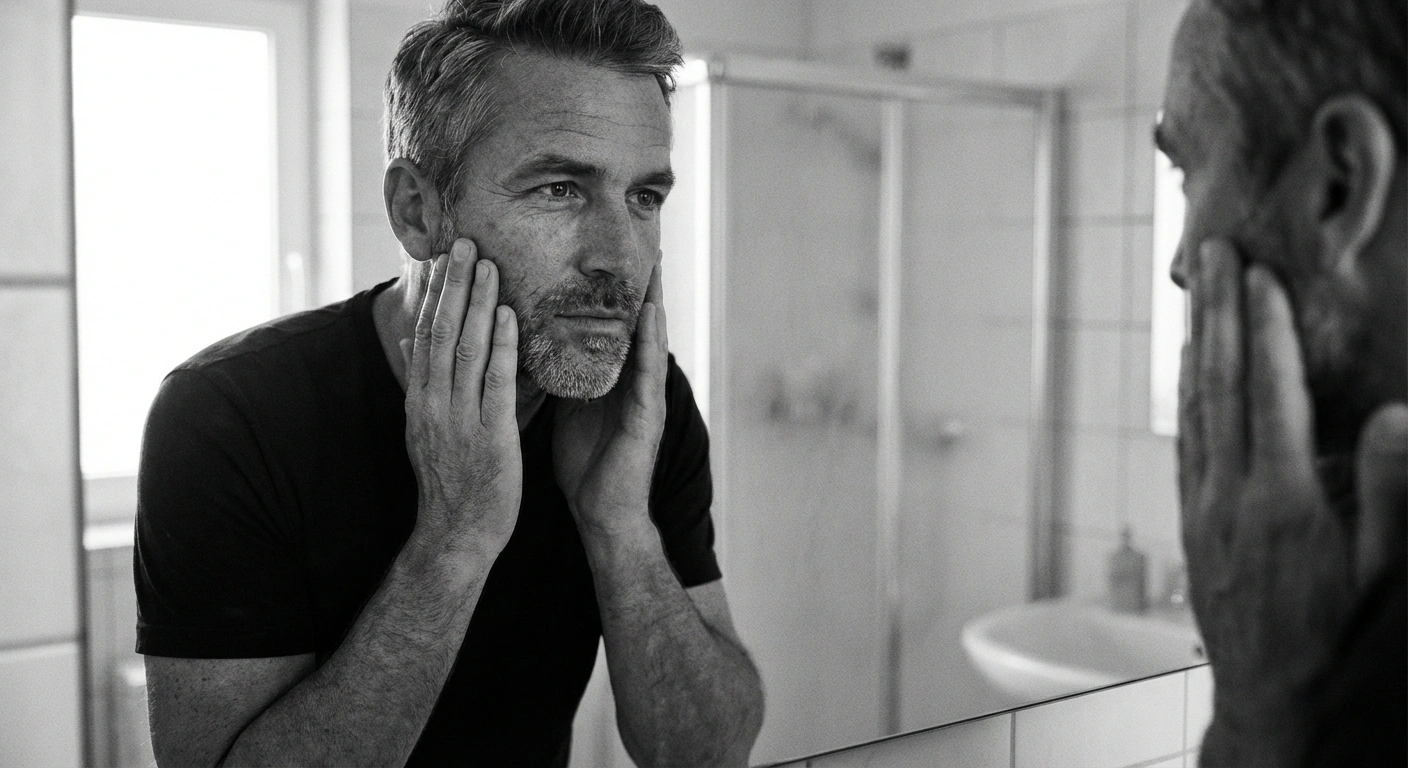
Eighty percent of visible facial aging comes from sun exposure. Not genetics. Not stress. Not "getting older." Ultraviolet radiation breaks down collagen and elastin in your skin the same way it cracks a car dashboard left in the sun for a decade. By age 40, you've already lost roughly 24% of your dermal collagen, according to research published in the American Journal of Pathology. That number climbs another 1% every year after.
This is not a vanity problem. Skin cancer is the most common cancer in the United States, and men over 40 account for a disproportionate share of melanoma deaths. The American Academy of Dermatology reports that men are twice as likely to die from melanoma as women, largely because they skip sun protection and delay doctor visits.
The fix requires four products. Two minutes in the morning. Two minutes at night. Total monthly cost starts at $13. The evidence behind each product is stronger than the evidence behind most supplements you're probably already taking.
Why Most Men Get This Wrong
The average man washes his face with bar soap. That bar soap has a pH of 9 to 10. Your skin's natural pH sits between 4.5 and 5.5. A study in Dermatology found that washing with alkaline soap disrupts the acid mantle, a thin film on your skin's surface that keeps bacteria out and moisture in. Destroy that barrier, and your skin overproduces oil to compensate, which creates the exact greasiness you were trying to wash away.
Then there's the sunscreen problem. Men skip it because they associate it with beach vacations, not daily life. But UV radiation penetrates clouds, car windows, and office windows. A 2017 analysis in the Journal of the American Academy of Dermatology found that men applied sunscreen at less than half the rate of women, despite having higher rates of squamous cell carcinoma, basal cell carcinoma, and melanoma.
The final misconception: skincare equals vanity. Dermatologists classify sunscreen and retinoids as medical-grade interventions. Sunscreen prevents cancer. Retinol is a vitamin A derivative that reverses DNA damage from UV exposure. Calling these products "cosmetics" is like calling a toothbrush a beauty tool. You brush your teeth to prevent decay and disease. You apply sunscreen and retinol for the same reasons, just on a different organ.
Your skin is your largest organ. It weighs about eight pounds. Treat it like one.
Morning Step 1: Cleanser
Your morning cleanser has one job: remove overnight oil and sweat without stripping your skin barrier. That means a pH-balanced, non-foaming formula. Skip anything that makes your face feel "squeaky clean." That sensation means you've destroyed your lipid barrier, and your skin will spend the rest of the day overproducing sebum to repair the damage.
A study published in the Journal of the American Academy of Dermatology tested cleansers across a range of pH levels and found that products with a pH above 7.0 significantly impaired barrier recovery compared to those formulated at pH 5.5 or below. The researchers concluded that syndet (synthetic detergent) cleansers outperformed traditional soaps for maintaining skin integrity.
Product pick: CeraVe Hydrating Facial Cleanser (~$15)
Contains ceramides (the lipid molecules that make up 50% of your skin barrier) and hyaluronic acid for moisture retention. pH-balanced at 5.5. Fragrance-free. One bottle lasts two to three months.
Alternative approach: If your skin isn't oily in the morning, skip the cleanser entirely and rinse with lukewarm water. Multiple dermatologists, including Dr. Sandy Skotnicki of the University of Toronto, recommend this for men with normal-to-dry skin. Save the cleanser for the evening, when you actually have sunscreen and grime to remove.
Morning Step 2: Sunscreen SPF 30+
This is the single most important product in your routine. Full stop. If you only buy one thing from this list, buy sunscreen.
The landmark Nambour Skin Cancer Prevention Trial in Australia followed 1,621 adults for over a decade in a randomized controlled trial. The group assigned to daily sunscreen application saw a 40% reduction in squamous cell carcinoma. A follow-up analysis published in the Journal of Clinical Oncology found that the daily sunscreen group had a 50% lower rate of melanoma ten years later. This was not correlational data. It was a randomized controlled trial, the gold standard of medical evidence.
A separate study in the Annals of Internal Medicine (the CMAJ sunscreen aging trial) found that daily sunscreen users showed 24% less skin aging over 4.5 years compared to the discretionary-use group. The sunscreen group's skin literally aged slower on a cellular level, as measured by microtopography, a technique that maps the depth and density of wrinkles.
Men face a specific risk here. The Skin Cancer Foundation reports that men over 50 have the highest rate of melanoma of any demographic group. Men also tend to develop skin cancer on the face, ears, and neck at higher rates than women, likely because they spend more time outdoors without protection and are less likely to wear hats or apply sunscreen.
Product pick: EltaMD UV Clear Broad-Spectrum SPF 46 (~$39)
This is the dermatologist's sunscreen. Contains 9% zinc oxide (physical blocker) and 7.5% octinoxate (chemical filter) for broad-spectrum UVA/UVB protection. Also includes 5% niacinamide (vitamin B3), which reduces redness and doubles as a lightweight moisturizer. If your skin tends toward oiliness, this formula works well. It dries matte, leaves no white cast, and sits comfortably under clothing.
Budget pick: CeraVe Hydrating Mineral Sunscreen SPF 30 (~$16)
Zinc oxide-based, fragrance-free, includes ceramides. Slightly thicker than the EltaMD but costs less than half the price. One tube covers roughly six weeks of daily facial application.
Application note: Use a nickel-sized amount for your entire face. Most people under-apply by 50%, which drops an SPF 30 product to about SPF 10 in practice. Apply 15 minutes before sun exposure. Reapply every two hours if you're outdoors. For desk workers, a single morning application covers you until evening.
Evening Step 1: Cleanser
Same cleanser. Same technique. But this step is non-negotiable, even if you skipped the morning wash. By evening, your face has accumulated sunscreen residue, environmental pollutants, sebum, and dead skin cells. Leaving that layer on overnight creates a breeding ground for bacteria and accelerates oxidative damage.
Double-cleansing (using an oil-based cleanser first, then your regular cleanser) is popular in K-beauty circles, but unnecessary for most men. A single wash with your CeraVe removes sunscreen effectively. If you wear a mineral sunscreen with heavy zinc oxide, you may need 30 seconds of gentle massaging rather than a quick splash. Pat dry with a clean towel. Don't rub.
Evening Step 2: Retinol
Retinol is a derivative of vitamin A and the most studied anti-aging compound in dermatology. Nothing else comes close in terms of evidence quality and volume.
A meta-analysis published in Scientific Reports reviewed 23 randomized controlled trials and found that topical retinoids produced an odds ratio of 14.10 for wrinkle improvement compared to placebo. For context, an odds ratio above 2 is considered clinically meaningful. Retinoids exceeded that benchmark by a factor of seven.
A separate study in JAMA Dermatology examined the effects of tretinoin (prescription-strength retinoid) on photoaged skin and found significant improvements in fine lines, rough texture, and hyperpigmentation within 24 weeks. The researchers confirmed increased collagen I and collagen III synthesis in skin biopsies, meaning retinoids don't just make skin look better on the surface. They rebuild the structural protein matrix underneath.
Retinol works through a straightforward mechanism. Your skin converts retinol to retinaldehyde, then to retinoic acid (the active form). Retinoic acid binds to nuclear receptors in skin cells and increases cell turnover, meaning damaged surface cells shed faster and fresh cells replace them. It also stimulates fibroblasts, the cells responsible for producing collagen and elastin.
Product pick: The Ordinary Retinol 0.5% in Squalane (~$8)
Eight dollars. That's not a typo. The Ordinary stripped out the marketing budgets and fragrance labs and sells effective formulations at commodity prices. The 0.5% concentration sits in the sweet spot: strong enough to produce visible results, mild enough to avoid the severe irritation that 1.0% formulas can cause. Squalane (a lipid naturally present in your skin) serves as the delivery vehicle, which keeps the formula moisturizing rather than drying.
Alternative pick: CeraVe Resurfacing Retinol Serum (~$21)
Contains encapsulated retinol (which releases gradually and reduces irritation), plus ceramides and niacinamide. A good choice if your skin tends toward sensitivity or dryness. Slightly less potent than The Ordinary but better tolerated by beginners.
How to start: Apply a pea-sized amount to clean, dry skin two to three nights per week for the first two weeks. Your skin needs time to build tolerance to retinol. During this adjustment period, expect mild flaking, slight redness, and temporary dryness. This is called retinization and resolves within 10 to 14 days for most people. After two weeks, increase to every other night. After four weeks, use nightly if tolerated.
Critical rules for retinol use:
- Apply at night only. UV radiation degrades retinol and can cause photosensitivity.
- Wait until your face is completely dry after washing. Applying retinol to damp skin increases penetration and irritation.
- Don't mix with vitamin C, AHAs, or BHAs in the same application. These combinations can cause excessive irritation.
- Wear sunscreen the next morning. Retinol increases your skin's UV sensitivity. This is non-optional.
The Optional Upgrade: Vitamin C Serum
If four products feel manageable and you want to optimize further, a morning vitamin C serum is your strongest addition. Apply it after cleansing and before sunscreen.
L-ascorbic acid (the active form of vitamin C) serves two functions. First, it's a potent antioxidant that neutralizes free radicals generated by UV exposure and pollution. Second, it's a required cofactor for collagen synthesis. A study in the American Journal of Clinical Nutrition found that topical vitamin C increased collagen production by 120% to 191% in photoaged skin. Research published in Photodermatology, Photoimmunology & Photomedicine demonstrated that combining vitamin C with sunscreen provided significantly better UV protection than sunscreen alone.
The challenge with vitamin C serums: they oxidize fast. A good formulation needs L-ascorbic acid at 10-20% concentration, vitamin E (tocopherol), and ferulic acid to stabilize the formula. The original research behind this combination came from Dr. Sheldon Pinnell at Duke University, and the resulting patent led to the creation of SkinCeuticals C E Ferulic, which retails for $182. You don't need to pay that.
Product pick: Maelove The Glow Maker (~$33)
Contains 15% L-ascorbic acid, vitamin E, ferulic acid, and hyaluronic acid. Same active formula as the SkinCeuticals product at roughly one-fifth the price. Independent testing has verified its potency and pH (below 3.5, which is necessary for vitamin C absorption). One bottle lasts about two months.
Application: Three to four drops on clean skin in the morning. Let it absorb for 60 seconds, then apply sunscreen over it. Store the bottle in a cool, dark place. If the serum turns orange or brown, it has oxidized and lost efficacy. Replace it.
The Shopping List
Three builds depending on your budget. All prices approximate. Each build lasts roughly two to three months per purchase.
Budget Build (~$39 total)
| Product | Price | When |
|---|---|---|
| CeraVe Hydrating Facial Cleanser | $15 | Morning + Evening |
| CeraVe Hydrating Mineral Sunscreen SPF 30 | $16 | Morning |
| The Ordinary Retinol 0.5% in Squalane | $8 | Evening |
Optimal Build (~$75 total)
| Product | Price | When |
|---|---|---|
| CeraVe Hydrating Facial Cleanser | $15 | Morning + Evening |
| EltaMD UV Clear Broad-Spectrum SPF 46 | $39 | Morning |
| CeraVe Resurfacing Retinol Serum | $21 | Evening |
With Vitamin C (~$108 total)
| Product | Price | When |
|---|---|---|
| CeraVe Hydrating Facial Cleanser | $15 | Morning + Evening |
| Maelove The Glow Maker (Vitamin C) | $33 | Morning (before sunscreen) |
| EltaMD UV Clear Broad-Spectrum SPF 46 | $39 | Morning |
| CeraVe Resurfacing Retinol Serum | $21 | Evening |
Compare these costs to the supplements in your cabinet. A month of premium magnesium supplements costs $15 to $30. A basic testosterone support stack runs $40 to $80. Skincare products with decades of clinical trial data behind them cost the same or less, and the evidence is substantially stronger.
Common Objections
"I don't need skincare."
You wouldn't skip brushing your teeth because you "don't need dental care." Sunscreen is the same category. It prevents cancer. Retinol reverses accumulated DNA damage. These are medical interventions applied to your body's largest organ. The question isn't whether you need them. The question is why you've gone this long without them.
"Retinol will make my skin peel."
It might, for about two weeks. Mild flaking during the retinization period is normal and temporary. Start with two applications per week. Your skin adapts. If the irritation is severe, drop to once per week or switch to a lower concentration (0.25%). By week three or four, most men report zero irritation and noticeably smoother skin texture.
"Sunscreen feels greasy."
That was true in 2005. Modern mineral and chemical sunscreens have transformed. EltaMD UV Clear dries matte. CeraVe's mineral formula absorbs within 60 seconds. If you've avoided sunscreen because of a bad experience with a Coppertone bottle at the beach 15 years ago, try a facial-specific formula. The difference is significant.
"This is too expensive."
The budget build costs $39 for roughly three months of daily use. That's $13 per month. A single co-pay for a dermatologist visit costs more. A skin cancer biopsy costs $150 to $400 out of pocket. A Mohs surgery procedure to remove skin cancer averages $2,500. Prevention is cheaper than treatment, every time.
"I'm already 45. Is it too late?"
No. The CMAJ sunscreen trial enrolled adults with an average age of 49 and still demonstrated measurable reductions in skin aging. Retinoid studies have shown collagen rebuilding in subjects aged 50 to 70. Your skin retains the capacity to repair itself. Starting now prevents further accumulation of UV damage and begins reversing existing photoaging. The best time to start was 20 years ago. The second best time is today.
The Routine at a Glance
Morning (90 seconds)
- Wash with CeraVe Hydrating Cleanser (or rinse with water)
- Apply sunscreen SPF 30+ to face, ears, and neck
Evening (90 seconds)
- Wash with CeraVe Hydrating Cleanser
- Apply retinol to clean, dry skin (start 2-3x per week)
That's it. No toners. No essences. No 12-step routines. Four products that address the two primary drivers of skin aging: UV damage (sunscreen) and collagen loss (retinol). Cleanser supports both by maintaining the barrier that keeps everything functioning.
Your skin quality affects how you look, how others perceive your age, and your risk of the most common cancer in America. It also affects how well you sleep, since skin discomfort and inflammatory skin conditions are linked to poor sleep quality. Men who take their health seriously enough to train, watch their testosterone levels, and build longevity habits should apply the same discipline to their skin. The evidence demands it.
Frequently Asked Questions
What SPF level do men over 40 need?
SPF 30 blocks 97% of UVB rays and is sufficient for daily use. SPF 50 blocks 98%. The difference between SPF 30 and SPF 50 is marginal. The far more important factor is applying enough product (a nickel-sized amount for the face) and reapplying every two hours during extended outdoor exposure. The American Academy of Dermatology recommends SPF 30 as the minimum for daily use.
Can men use retinol every night?
Yes, after a four-to-six-week adjustment period. Start with two to three applications per week and increase frequency as your skin builds tolerance. Most men can use retinol nightly within one month. If you experience persistent redness or peeling beyond the initial two-week retinization phase, reduce frequency or switch to a lower concentration.
Does retinol make your skin more sensitive to the sun?
Yes. Retinol increases epidermal cell turnover, which means newer, thinner skin cells are exposed at the surface. These cells are more susceptible to UV damage. This is why you apply retinol at night and wear sunscreen every morning. The two products work as a system: retinol repairs, sunscreen protects.
What's the difference between retinol and tretinoin?
Retinol is an over-the-counter vitamin A derivative. Your skin converts it to retinoic acid (the active form) through a two-step process. Tretinoin is prescription-strength retinoic acid that works immediately without conversion. Tretinoin produces faster, more dramatic results but causes more irritation. For most men starting a skincare routine, over-the-counter retinol provides effective results with fewer side effects. If you want tretinoin, ask your dermatologist for a prescription.
How long before I see results from this routine?
Sunscreen benefits are cumulative and preventive, so you won't "see" results immediately, but damage prevention starts on day one. Retinol produces visible improvements in skin texture and fine lines within 8 to 12 weeks, based on the timeline observed in clinical trials. Full collagen remodeling effects take 6 to 12 months of consistent use. Skincare is a long game, similar to strength training: consistency over months produces results that no short-term intervention can match.
Key Takeaways
- 80% of visible facial aging comes from UV exposure, not genetics or chronological age.
- Sunscreen is a cancer-prevention tool, not a cosmetic. A 10-year RCT demonstrated 40% reduction in squamous cell carcinoma and 50% reduction in melanoma with daily use.
- Retinol is the most evidence-backed anti-aging compound in dermatology, with a meta-analysis of 23 RCTs showing an odds ratio of 14.10 for wrinkle improvement.
- The budget build costs $39 for three months of daily use: cleanser, sunscreen, and retinol.
- Start retinol slowly (2-3 nights per week) and always pair with morning sunscreen.
- Men over 40 face higher skin cancer risk than women and use sunscreen at less than half the rate. Close that gap.
Medical disclaimer: This article is for informational purposes only and does not constitute medical advice. Consult your dermatologist or healthcare provider before starting any new skincare regimen, especially if you have existing skin conditions, take photosensitizing medications, or have a history of skin cancer. The product recommendations in this article are not sponsored and reflect the editorial team's independent research.
Medical Disclaimer: This article is for informational purposes only and does not constitute medical advice. Always consult your healthcare provider before starting any new exercise, nutrition, or supplement program.